
Most law firms rely on a combination of case management software, document automation tools, billing platforms and litigation support systems to streamline operations, improve accuracy, and enhance client service.
These tools centralize case data, automate workflows, and strengthen compliance, making them essential for modern legal practices.
This blog helps firm leaders understand the software law firms use, why it matters, types of solutions available, and how to choose the best software for law firms for long-term growth.
The personal injury legal industry is undergoing a profound digital transformation. In a sector driven by documentation, deadlines, compliance, and client trust, technology has become one of the most powerful competitive differentiators.
According to Thomson Reuters Legal Technology Study, 89% of law firms report that technology has become essential to their day-to-day operations and 67% plan to increase investment in legal software over the next two years.
The shift is driven by two realities: clients expect faster communication, full transparency, and digital access, while internal workflows are getting more complex, pushing firms to modernize and cut administrative load.
In this environment, knowing what software law firms use isn’t optional, it is essential for leaders who want to boost profitability, reduce risk, and elevate the client experience.
What exactly is legal software, how are top firms using it to boost productivity, which tools matter most today, and how do you choose the right platform for your practice? Let’s find out.
What Is Legal Software?
Legal software refers to specialized digital tools designed exclusively for legal professionals. Unlike general office applications, legal application software supports workflows unique to law practices such as case intake, legal calendaring, document versioning, evidence organization, medical record handling, trust accounting, and matter-specific reporting.
Its purpose is to reduce complexity, increase accuracy, and give legal teams the infrastructure they need to manage cases efficiently. As firms scale, these tools ensure processes remain consistent, secure, and compliant with regulatory requirements.
Legal software typically includes capabilities such as:
- Case and matter management
- Document creation and automated templates
- Medical record organization (critical for PI firms)
- Time tracking and billing
- Secure communication
- Reporting and analytics
- Court deadline automation
- Role-based data access
As regulations tighten and data volumes grow, modern firms increasingly rely on technology for law firms to operate at the pace clients expect.
How Law Firms Use Technology to Improve Productivity
Productivity has become a strategic priority for law firm leaders. A 2023 ABA study found that lawyers spend nearly 40% of their time on non-billable administrative tasks. Technology helps reclaim that lost time, ensuring lawyers focus on legal work rather than manual processes.
Here’s how firms use modern tools to improve operational efficiency:
Automation of Routine Tasks
Administrative tasks such as scheduling, follow-ups, client updates, and document creation consume significant staff hours. With advanced attorney practice management software, firms automate repetitive processes, standardize workflows, and reduce the risk of errors. This saves time while ensuring consistency across cases.
Reducing Human Error
Legal work is highly sensitive to documentation quality and deadlines. Missed court dates or incorrect file versions can have major consequences. Technology reduces these risks through:
- Automated reminders
- Deadline monitoring
- Built-in workflows
- Secure document versioning
These systems ensure that no critical task falls through the cracks.
Enhancing Team Collaboration
With hybrid work becoming common, collaborative platforms have become essential. Software for lawyers centralizes case files, simplifies task allocation, and ensures every team member has real-time access to accurate data. This eliminates the inefficiencies of email-based coordination and siloed information.
Delivering Better Client Experience
Clients expect faster communication and digital accessibility. Tools such as secure portals, automated updates, and online intake forms allow firms to improve transparency and responsiveness. The result is stronger trust, better retention, and improved referral rates.
Strengthening Security and Compliance
Security breaches are a growing concern. With cyberattacks targeting law firms at increasing rates, modern software provides advanced protection including encryption, access controls, and audit logs. Solutions such as case management software for law firms also help enforce compliance with HIPAA and PII regulations—especially for personal injury and medical-driven cases.
Increasing Billable Efficiency
Efficiency gains directly impact revenue. By reducing time spent on routine tasks, firms increase capacity for billable work. Studies show that firms using modern legal software see productivity improvements ranging from 20% to 50%, depending on the level of automation adopted.
What Types of Software Do Law Firms Use?
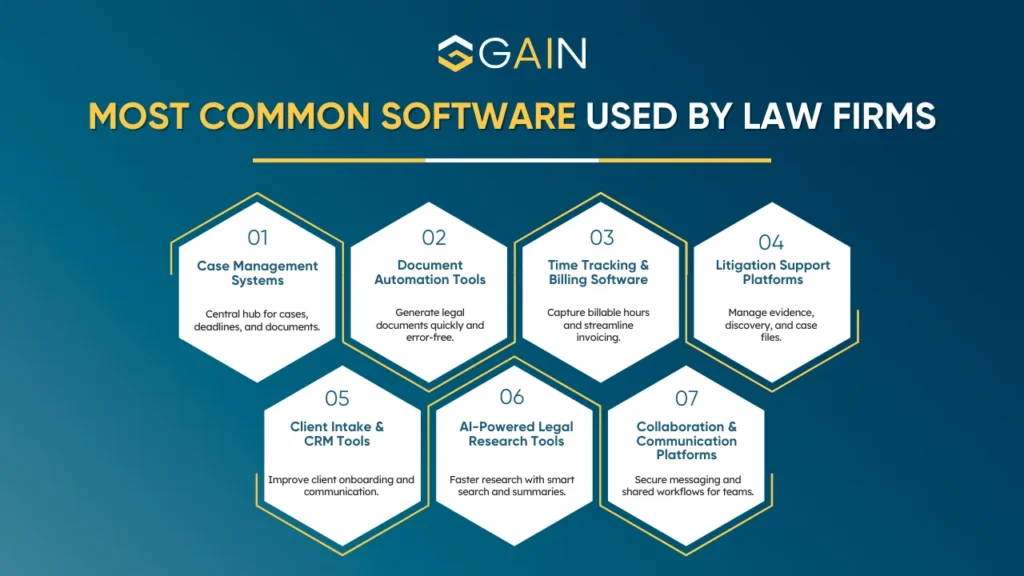
To understand the software law firms use, it’s useful to look at the core categories adopted across firms of all sizes. These solutions are essential in helping firms manage caseloads, reduce administrative burdens, and scale operations efficiently.
1. Case Management Software
Case management software serves as the operational core of most law firms, unifying documents, communication, tasks, medical records, calendars, notes, and billing into a single structured system. Many firms rely on advanced case management software for law firms to streamline workflows and reduce administrative burden.
Personal injury practices, in particular, benefit from strong medical record organization and timeline tracking, which is why choosing the right case management software for personal injury lawyers becomes essential for managing high-volume cases efficiently.
2. Document Automation and Management Tools
Document creation remains one of the most time-intensive aspects of legal work. Platforms specializing in document automation streamline drafting, enable eSignatures, and support secure cloud-based storage.
These tools are indispensable for firms that deal with complex contracts, agreements, and medical files.
For firms handling medical data or injury-related cases, new technology for law firms becomes an essential part of maintaining accuracy and improving case preparation.
3. Litigation Support Software
Litigation practices rely heavily on technology for organizing discovery, evidence, transcripts, and trial materials. Litigation support software helps teams handle data-heavy cases and prepare for court efficiently.
4. Billing, Time Tracking & Accounting Platforms
Accurate billing is essential for firm profitability. Legal billing systems automate time tracking, streamline invoice creation, and maintain compliance with trust accounting rules. These tools reduce financial errors and improve revenue capture.
5. Client Intake and CRM Systems
Client intake has a direct impact on firm growth. Modern CRM tools enable firms to automate lead follow-ups, digitize intake forms, and centralize client communication. This prevents lost leads and creates a seamless onboarding experience.
6. AI-Powered Legal Research Tools
AI is transforming legal research by accelerating document review, summarizing case law, predicting outcomes, and speeding up brief drafting. While these tools don’t replace human judgment, they significantly reduce the hours spent on manual research.
7. Communication and Collaboration Platforms
Secure portals, video conferencing tools, shared calendars, and encrypted messaging platforms are essential for modern legal operations. These channels help attorneys communicate efficiently while ensuring sensitive information remains protected.
What’s the Best Software for Law Firms?
Determining the best software for law firms requires an understanding of the firm’s size, specialization, caseload, reporting needs, and internal processes. Decision-makers should assess tools based on the key features of case management software and following factors:
Unified Case Management Structure
A strong case management software core ensures all workflows—intake, documents, communication, and billing—operate from a single system.
Advanced Security Infrastructure
Firms must prioritize encryption, audit trails, and role-based access. These features protect sensitive data and ensure compliance with regulatory standards.
Automation Capabilities
Automation differentiates modern systems. Look for automated workflows for document creation, reminders, deadline tracking, intake routing, and client communication.
Seamless Integrations
The ideal solution integrates with:
- Email and calendars
- Document storage
- Accounting software
- eSign tools
- AI research platforms
This allows firms to maintain a continuous and efficient workflow.
Practice-Area Customization
Different practice areas have unique requirements:
- PI firms need medical record automation
- Litigation firms need deposition and evidence management
- Corporate firms need contract automation
Scalability and Ease of Use
Software should grow with the firm and be easy for teams to adopt. A complicated interface slows adoption and reduces ROI.
Choosing the Right Legal Software Is a Strategic Advantage
Legal technology is no longer a convenience—it is a strategic imperative. As caseloads grow, client expectations rise, and competition intensifies, the software law firms use directly impacts productivity, accuracy, and long-term profitability.
Decision-makers must evaluate software not just for features, but for how well it integrates into the firm’s unique workflows, practice areas, and long-term growth plans.
The right technology becomes a force multiplier—reducing administrative burden, improving team collaboration, and increasing the firm’s capacity to take on more cases without increasing overhead.
Looking to streamline your entire legal workflow, from intake to settlement with one powerful platform? Gain Servicing helps law firms automate case management, simplify medical records handling, reduce administrative load, and accelerate case outcomes.
FAQs
What software do law firms use?
Most law firms use case management software, document automation systems, billing platforms, CRM tools, and litigation support software to streamline operations and manage cases effectively.
What kind of technology do lawyers use?
Lawyers rely on tools such as case management systems, eDiscovery platforms, AI research tools, secure communication systems, and billing software to improve productivity and accuracy.
Which is the best AI tool for lawyers?
The best AI tools assist with legal research, contract analysis, and document review. The ideal tool depends on the practice area and integration needs of the firm.
Why do law firms need specialized legal software?
Specialized legal software supports compliance, manages sensitive data, organizes case information, and automates repetitive tasks—ensuring efficiency and reducing risk.
Can law firm software integrate with other platforms?
Yes. Modern legal systems integrate with calendars, accounting tools, eSign platforms, document storage, and email systems to provide a unified workflow.
Why do law firms need specialized software?
Legal work involves unique workflows, strict deadlines, and sensitive data. Specialized tools ensure accuracy, streamline processes, and support long-term growth.