
TL;DR
Case management software is a centralized platform that helps law firms organize cases, manage documents, automate workflows, and track deadlines in one system. For personal injury firms, the benefits extend to medical record coordination, lien tracking, and settlement management without the manual follow-up that slows most practices down.
This guide covers what case management software does, the core features PI firms need, the key benefits, and what to look for when evaluating platforms.
Case management software is a platform that centralizes everything involved in managing legal matters. It replaces scattered emails, spreadsheets, and paper files with a structured system where case data, documents, communications, and deadlines all live in one place.
For personal injury firms, the stakes are higher. PI cases involve coordinating multiple medical providers, tracking liens, managing Letters of Protection, and monitoring statute windows. When firms handle this through email and spreadsheets, records go missing and deadlines get missed.
This guide explains what case management software does, the features that matter most for PI practices, and the advantages of case management software over manual processes.
What Does Case Management Software Do?
more than organize information. It coordinates the medical, legal, and financial stages of aCase management software connects every part of a case into one structured workflow. Rather than tracking updates across email, phone calls, and separate documents, the platform creates a single case record that every team member works from.
It typically handles five core workflows:
- Case and client management: every case has a structured profile with client details, matter type, assigned staff, and real-time status.
- Document storage and retrieval: files are uploaded, tagged, and searchable, so any record is found in seconds rather than minutes.
- Communication and task management: internal messages, deadline reminders, and task assignments are tied to the case rather than scattered across inboxes.
- Medical and financial tracking: for PI firms, this includes treatment status, lien balances, and settlement progress.
- Reporting and analytics: dashboards show case aging, staff workload, and financial exposure across the full docket.
Understanding what these workflows look like in a PI context starts with understanding what case management means at the operational level.
Why Personal Injury Firms Need Case Management Software
General legal software handles scheduling and billing reasonably well. Personal injury law firm case management software has to go further because PI cases involve complexity that standard platforms were not built for.
A typical PI case requires:
- Coordinating care across multiple medical providers over several months
- Collecting records from each provider individually and tracking their status
- Managing a Letter of Protection alongside the lien amounts owed at settlement
- Monitoring a statute of limitations deadline that cannot be extended
- Allocating settlement funds accurately among the attorney, providers, and client
None of these steps fits neatly into a generic task management tool. The right case management software personal injury firms need treats medical coordination, lien tracking, and settlement management as core features, not workarounds built on top of a general billing system.
The difference becomes obvious when cases move into the settlement phase. Firms without dedicated tracking routinely discover unperfected liens or missing records at the exact moment they need a clean case file to close.
Core Features of Personal Injury Case Management Software
The features that matter most for PI firms are different from those that serve general practice. Here is what a purpose-built platform should cover.
Client Intake and Case Profiles
A good platform captures all relevant details at the first contact: accident date, parties involved, insurance information, treatment status, and attorney assignment. This creates a complete case record before any billable work begins.
Weak intake creates downstream problems. Missing insurance details delay filings. Incomplete treatment records weaken demand packages. Getting intake right at the start prevents the most common and costly PI billing errors.
Document Management and Medical Record Tracking
Every PI case generates a high volume of documents: medical records, billing statements, demand letters, and settlement paperwork. Purpose-built legal case management software organizes these by provider, date, and document type so any file is searchable and accessible within seconds.
Medical record tracking goes further. The platform logs request status, flags overdue responses, and organizes incoming records chronologically so demand packages can be assembled without hunting through email threads.
Workflow Automation and Deadline Management
Workflow automation is one of the most practical advantages of case management software for PI firms. When a treatment milestone is reached, the system triggers the next step automatically: a record request goes out, a follow-up is scheduled, or a paralegal is alerted without anyone initiating it manually.
Statute of limitations tracking works the same way. Deadlines are flagged at set intervals with escalations when no action is taken, removing the biggest malpractice risk in a high-volume PI practice.
Lien and Settlement Management
Lien management is where many PI firms see the most immediate return from a dedicated platform. The software tracks lien balances, provider billing updates, and reduction requests in one place, so the full financial picture is visible before settlement negotiations begin.
Settlement tracking then follows: demand amounts, insurer responses, negotiation history, and final allocation among attorney fees, liens, and client recovery. This level of visibility is one of the key benefits of case management software for plaintiff-side PI practices.
Collaboration and Communication
Attorneys, paralegals, and case managers often work across different stages of the same matter. A good platform keeps communication tied to the case record rather than scattered across email. Messages are timestamped, tasks are assigned, and every team member works from current information.
Reporting and Case Analytics
Reporting dashboards show case aging, pending demands, treatment completion rates, and settlement averages across the full docket. This gives partners the data they need to manage workload and identify bottlenecks without asking individual attorneys for status updates.
For PI firms managing over a hundred active cases, this visibility is not optional. Without it, leadership is always reacting to problems rather than catching them early. Good reporting turns operational data into decisions before bottlenecks become delays.

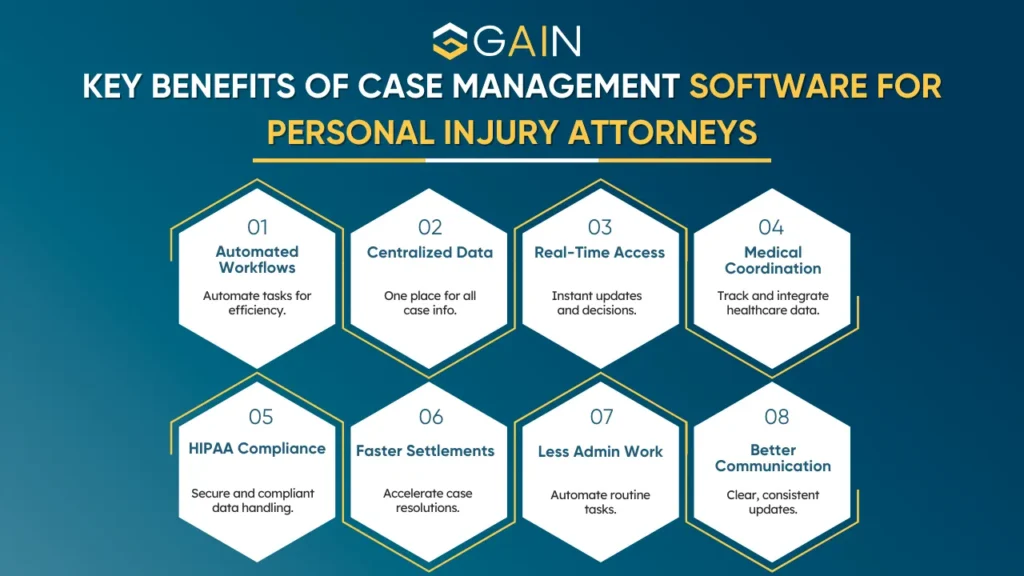
Key Benefits of Case Management Software for PI Firms
The case management software benefits are most visible in PI-specific platforms rather than tools adapted from general legal practice.
Benefit | What It Means in Practice |
Faster case resolution | Automated workflows reduce delays between treatment, records, and demand |
Fewer missed deadlines | Statute alerts and task escalations prevent the costliest PI errors |
Stronger demand packages | Organized records and complete billing create better settlement leverage |
Reduced admin burden | Staff spend less time chasing records and more time on case work |
Better lien accuracy | Tracked balances and reduction requests prevent post-settlement disputes |
Full case visibility | Dashboards show every active matter without individual check-ins |
Improved client experience | Automated updates keep clients informed without adding staff time |
The advantages of case management software compound over time. Firms using structured platforms consistently build better operational foundations than those relying on spreadsheets. The full breakdown of how benefits of case management software play out across different firm sizes is covered in a dedicated guide.
What Happens Without Case Management Software?
The cost of not using a purpose-built platform is real but often invisible until it becomes a serious problem. Firms managing PI cases through email and spreadsheets typically face:
- Missed statute of limitations: the most irreversible error in PI practice, and the most likely to occur when deadlines live in personal calendars.
- Incomplete demand packages: records requested but not tracked, bills received but not linked to the matter, gaps discovered after the insurer has already responded.
- Delayed settlements: lien holders not identified or contacted until settlement is imminent, creating last-minute obstacles to disbursement.
- Staff dependency: when processes live in one person’s head, any turnover creates immediate operational risk.
- No operational visibility: partners cannot see case status, financial exposure, or workload distribution without asking each attorney individually.
These are predictable consequences of managing PI complexity with general-purpose tools. For context on how the industry has shifted, the guide on new technology for law firms covers how adoption patterns have changed as more PI firms recognize this operational gap.
How to Choose the Right Case Management Software for a PI Firm
Not every legal software for law firms is built for PI. Many platforms cover scheduling, billing, and document storage well but lack the medical coordination, lien tracking, and settlement management features that define a genuinely PI-capable system.
When evaluating platforms, focus on five questions:
- Does it support PI-specific workflows? Look for dedicated features for medical records, LOP tracking, lien management, and statute alerts as core functions, not workarounds.
- Is it built for collaboration? The platform should connect attorneys, paralegals, and medical providers without requiring separate communication tools.
- What does reporting look like? Can leadership see case aging, pending demands, and financial exposure across the full docket in real time?
- How does implementation work? A platform that takes months to configure delays the return on investment significantly. Ask for a realistic onboarding timeline.
- What is the total cost? Include setup, training, and ongoing support. A lower subscription price that still requires significant manual workarounds is not actually cheaper.