
TL;DR
Case management meaning, in legal terms, refers to how law firms and courts organize and manage every step of a case: intake, documentation, communication, deadlines, negotiations, and litigation preparation. It ensures accuracy, efficiency, and consistency throughout the life of a case.
This guide covers what case management means in simple terms, how case management conferences work in U.S. civil courts, how law firms manage cases internally step by step, and why attorneys are increasingly choosing case management software in 2026.
Anyone working through a lawsuit, whether as a client, an attorney, or court staff, eventually runs into the term case management. It sounds simple, but the actual meaning shifts depending on whether you are talking about a court process or a law firm’s internal workflow.
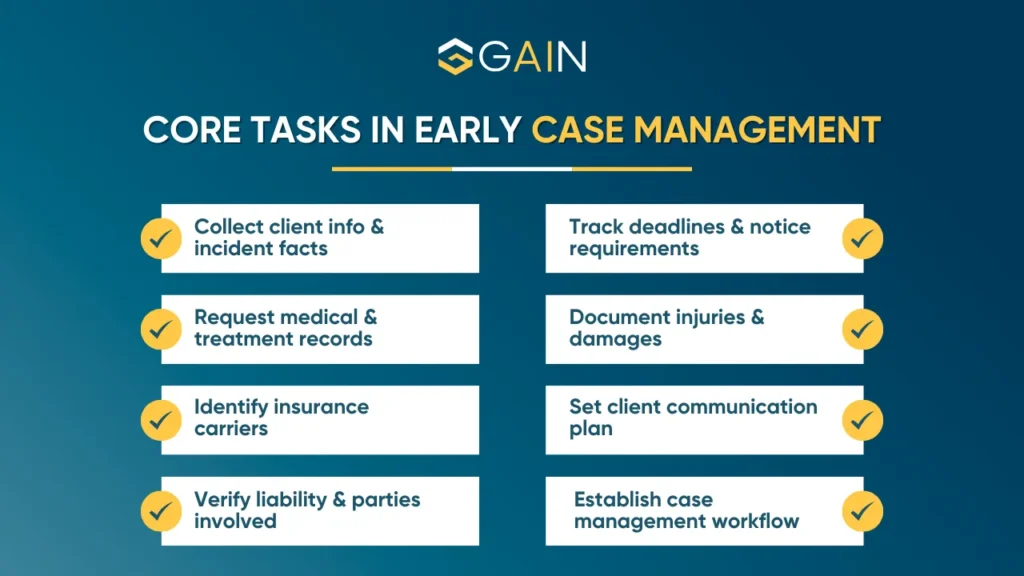
In legal practice, case management is the structured process of handling a case from the moment a client reaches out to the final resolution. For personal injury law firms, this includes coordinating information, collecting medical records, tracking treatment, managing insurance communication, and ensuring deadlines are met.
This guide breaks down what case management means in plain terms, how it plays out inside a civil court, how a personal injury firm actually manages a case day to day, and why so many firms are moving toward dedicated software to handle it.
What Is Case Management in Simple Terms?
What is case management in law? At its simplest, it is the organized handling of every moving piece in a legal case, so nothing gets lost between intake and resolution.
A single personal injury case may involve:
- Medical documentation
- Treatment updates
- Insurance communication
- Liability investigation
- Settlement preparation
Because PI cases rely heavily on medical data and communication histories, many firms use a case management platform for attorneys to keep all of this organized in one place rather than across emails and spreadsheets.
What Is a Case Management Conference?
A case management conference is a civil court meeting where the judge and attorneys outline how the case will move forward. Case management court meaning, in this context, refers to how the court schedules and structures each stage of a lawsuit. In personal injury matters within the United States, this conference helps establish expectations and keeps both sides progressing efficiently, whether the case is still in early discovery or nearing trial preparation.
A case management conference typically covers:
- Setting deadlines for discovery.
- Reviewing the status of medical records and treatment.
- Establishing the need for expert involvement
- Outlining motion schedules.
- Identifying issues that could delay the case.
Understanding case management hearing meaning ahead of time helps attorneys walk into these sessions prepared rather than reactively.
How Does Case Management Work Inside a Personal Injury Law Firm?
Under case management law, managing a personal injury case requires coordination across intake, documentation, communication, medical tracking, negotiation, and, in some cases, litigation. The process generally follows a predictable sequence from the first phone call through to settlement or trial.
1. Initial Intake and Case Opening
This is where the attorney or case manager first collects client and incident details and reviews the basics of liability. A digital case file is opened only after conflict checks are run, so all documents and communication can be stored securely from day one.
2. Medical Record Collection and Organization
What is case file management at this stage? It largely means requesting records from multiple providers, tracking what’s missing, and organizing bills and treatment summaries as they arrive.
- Requesting records from hospitals and specialists
- Categorizing documents by provider
- Tracking which records are pending
- Reviewing bills and treatment summaries
3. Liability Review and Evidence Tracking
Once medical records begin to come in, attorneys collect accident reports, review photos and videos, and interview witnesses to assess liability and identify what additional documentation is still needed.
4. Insurance Communication and Treatment Monitoring
Insurance adjusters play a central role in PI claims, so every call, email, and claim status update gets logged for future reference. At the same time, firms track the client’s treatment progress closely, since ongoing medical updates directly affect how the case gets valued.
5. Demand Letter Preparation
Once treatment reaches a stable point, attorneys prepare a demand package for the insurance carrier. This typically includes:
- Medical records and bills
- Lost wage documentation
- Pain and suffering summary
- Liability explanation and case value analysis
6. Negotiation and Litigation (If Needed)
Negotiations require precise documentation and consistent communication, including tracking offers and counteroffers and managing lien negotiations alongside client expectations. If a fair settlement is not reached, the firm moves into litigation, which means filing the complaint, managing discovery, scheduling depositions, and preparing for trial.
Why Are Attorneys Choosing Case Management Software in 2026?
In 2026, personal injury attorneys across the United States are increasingly choosing advanced case management platforms due to rising caseload volume, increased documentation requirements, and the need for more streamlined workflows. Attorney case management has shifted from manual tracking toward systems built specifically for this purpose.
- More accurate handling of medical records.
- Stronger oversight of insurance communication.
- Faster and more accurate demand preparation.
- Better collaboration between attorneys, paralegals, and case managers.
- Stronger compliance with court schedules and deadlines.
Reviewing real case management examples helps firms see how these platforms actually function day to day, beyond the feature lists.
What Makes Legal Case Management Software Worth Adopting?
The case management legal definition, or legal case management meaning, describes a structured workflow a law firm uses to handle a case from start to finish. Case management meaning law aside, the practical reality is straightforward: software built for this purpose simply does the job faster and with fewer errors than spreadsheets or email.
Looking at the features of a case management platform and the benefits of case management software makes it clear why so many firms are making the switch rather than sticking with manual processes.