Most law firms in the USA are feeling a productivity slump. Cases aren’t getting simpler, but the work around them keeps growing.
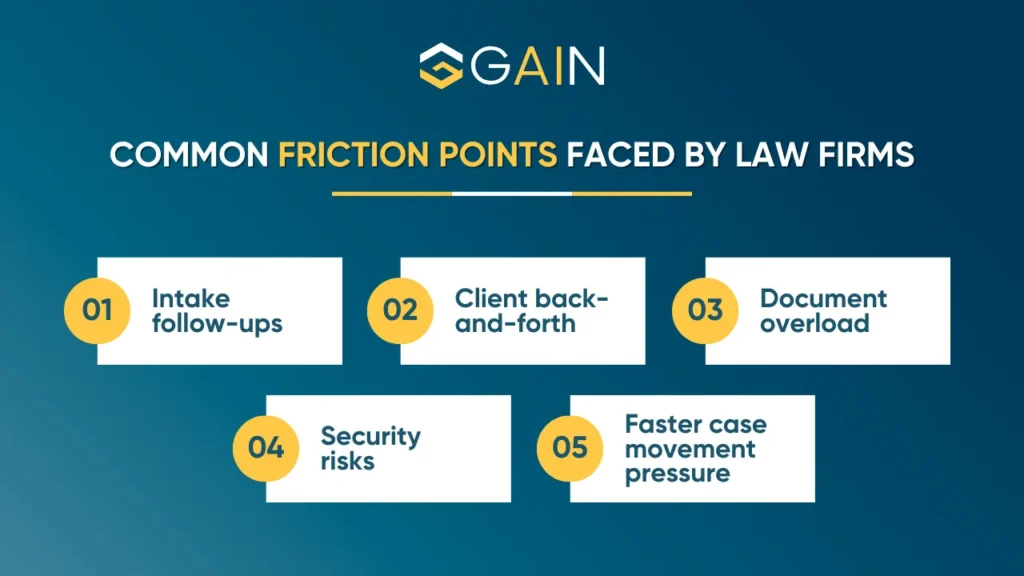
It’s the constant intake of follow-ups, the back-and-forth with clients, the never-ending documents, and the pressure to move matters forward faster. In the US, where expectations are high and security risks are real, running a firm can start to feel like you’re always playing catch-up.
This is exactly why legal software has become essential for firms that want to stay organised, reduce risk, and manage growing workloads more efficiently.
TL;DR: What is legal software?
At its simplest, legal software for law firms refers to purpose-built tools that help firms automate routine work. It helps keep everything in one place while reducing the day-to-day friction that slows teams down.
And the productivity upside is real. According to an industry survey, 61% of lawyers find capturing billable time time-consuming, with 48% confirming they spend “too much time” on it.
However, with the adoption of time-tracking tools, more than half of firms recorded additional billable time, while ABA report highlights that 9% reported at least 15 extra hours billed per month, as highlighted in this.
When you connect the dots, it’s easy to see why the right tools can directly impact both speed and margins.
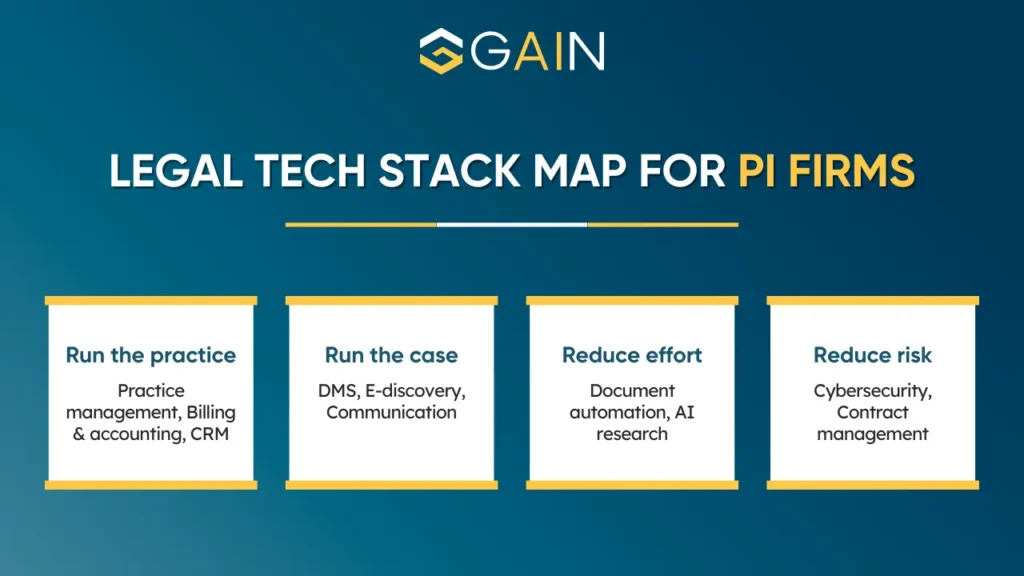
Today, the types of legal software available go far beyond basic case tracking. Most firms now use connected legal tech stacks that support smoother workflows.
For US law firms handling personal injury cases in particular, that structure becomes even more valuable. PI work is documentation-heavy, timeline-sensitive, and dependent on medical coordination and financial tracking.
With the right software law firms use, teams can move from reactive case handling to more structured and efficient workflows.
In this guide, we’ll break down 10 types of legal software that help firms work faster and smarter.
10 Types of Legal Software that Law Firms Must Have
1. Law Practice Management Software
If you’re building a reliable legal tech stack, practice management is usually the foundation.
It brings core operations into one place. This includes intake, matter details, tasks, calendaring, documents, time tracking, billing, and client communication. This way, your team isn’t constantly switching between disconnected tools.
For PI firms, that central hub matters even more. A single case can involve medical records, treatment updates, insurer communication, and multiple deadlines across different stages of the matter.
Modern law office software also helps firms maintain better visibility across day-to-day operations while reducing administrative friction tied to case handling. Strong law firm management processes become easier when operations stay connected in one system.
2. Document Management Systems (DMS)
Among the most valuable types of legal software, a DMS solves a problem many firms deal with daily: document sprawl.
A Document Management System is designed to store, organise, secure, and retrieve matter-related files and emails. These legal software systems help firms manage documents through client workspaces, access controls, version tracking, and searchable records.
For PI firms specifically, this becomes even more important because medical records, provider documents, settlement paperwork, and case-related files often continue expanding throughout the matter.
Several firms now consider DMS platforms among the best software for securing and tracking legal agreements, especially when handling sensitive client records and high volumes of documentation.
Features commonly associated with legal case management software also help firms organise records and maintain easier access to case-related documents.

3. Document Automation Tools
Once documents are organised, the next productivity jump is generating them faster. Document automation tools turn frequently used files into templates that can auto-fill using stored data or simple questionnaires.
And the payoff can be significant. According to Thomson Reuters, lawyers have reported up to 82% time savings when using document automation for legal documents.
For firms handling large volumes of paperwork, this type of software for lawyers can reduce repetitive drafting work and improve day-to-day efficiency.
4. Contract Management Systems
Contract management is one of those types of legal software that feels optional until your firm starts losing time searching for agreements, tracking renewals, or confirming obligations across multiple matters.
Contract management systems help keep agreements organised in one searchable location. Most platforms can track deadlines, manage reminders, maintain access controls, and support easier document retrieval during active matters.
These tools are often included within broader software for law firms designed to support document organisation and operational workflows.
5. Cybersecurity-Focused Legal Tech Software
Once your firm has a handle on documents and agreements, the next question becomes equally important: how well is that information protected?
For PI practices, this matters even more because firms regularly handle sensitive medical records, personal data, settlement information, and financial documentation.
The ABA’s 2023 Cybersecurity TechReport found that 29% of respondents said their firm had experienced a security breach, including hacks, stolen devices, break-ins, or website-related incidents.
This is why cybersecurity-focused tools remain one of the most essential types of legal software for law firms handling high volumes of confidential information.
Strong protection measures also work closely with secure managed IT services for law firms to help firms manage sensitive data more safely.
6. Legal CRM Systems
Leads come in from web forms, calls, chat, referrals, and ads. If follow-ups are inconsistent or delayed, good cases can slip away quietly. That’s why legal CRM platforms have become one of the most practical types of law firms software.
They help firms manage lead-to-client workflows by capturing inquiries, organising intake, automating follow-ups, scheduling consultations, and tracking pipeline activity.
Many firms also connect CRM workflows with broader law firm management structure processes to improve intake coordination and communication across teams.
7. Billing and Accounting Software
Once a lead becomes a client, the next question is how smoothly your firm manages billing, reporting, and financial tracking. That’s where billing and accounting tools earn their place within modern legal software solutions.
This category usually includes time tracking, invoicing, payments, trust accounting, and reporting tools. One industry survey found that 87% of firms use legal billing software to address billing-related challenges.
For PI matters, financial visibility may also involve tracking case costs, settlement timelines, and funding-related activity connected to ongoing matters.
8. E-Discovery Tools
E-discovery tools are becoming increasingly relevant even outside large litigation matters. They help teams collect, process, review, tag, and produce electronically stored information such as emails, PDFs, messages, images, videos, and other digital files.
Personal injury matters now involve growing volumes of digital evidence, including police reports, scene photos, dashcam footage, medical documentation, insurer communication, and social media content. As the volume increases, manual review can become difficult and time-consuming.
E-discovery platforms help legal teams organise evidence more efficiently while reducing delays during review. Many firms also include these capabilities within broader litigation management software workflows tied to document review and case preparation.
9. Law Firm Communication Tools
Even with strong case systems in place, many PI teams still lose time through scattered communication. When updates live across emails, texts, and separate platforms, decisions become harder to track and important context can get missed.
Law firm communication tools help create a more structured space for messaging, file sharing, notifications, and team coordination. Many modern software for attorneys platforms also include admin controls, permission settings, and audit trails to help firms manage sensitive communication more securely.
These communication features are often connected with broader new technology for law firms designed to improve coordination across legal teams.
10. AI-Enhanced Legal Research Tools
Research remains one of the largest time investments across the legal profession. Even in PI-focused practices, attorneys regularly review liability standards, damages, procedural issues, venue rules, evidentiary questions, and motion strategy.
One legal tech survey noted that legal professionals spend around 19% of work hours on research, on average.
AI-enhanced research tools help speed up early-stage research by identifying relevant authority, summarising information, and supporting faster issue spotting while still allowing attorneys to verify citations and rely on primary sources.