
TL;DR
Litigation management software is a centralized system that helps law firms manage litigation workflows, including case status, documents, communications, and tasks, from a single place. A strong litigation management system reduces the chaos that comes from running cases across disconnected tools.
This guide covers what litigation management software centralizes, the key features that matter most, how it boosts productivity, and how to choose the right platform for your firm.
If you’ve ever had to answer, “Where are we in this case?” and felt your brain instantly overwhelmed, you’re not alone. Litigation is messy by nature. But the work around litigation doesn’t have to be.
In 2026, expectations are sharper. Clients want updates faster. Case teams are leaner. And even one slow handoff can drag out timelines and inflate administrative costs. That’s why so many firms are making room for litigation management software as a core operational tool.
In this guide, we’ll break down why manual processes are cracking under modern pressure, and whether litigation management software is the solution most firms are looking for.
Why Manual Litigation Work Breaks Down in 2026
Most firms don’t choose manual operations on purpose. It’s usually the result of growth: more cases, more staff, more providers, more moving parts.
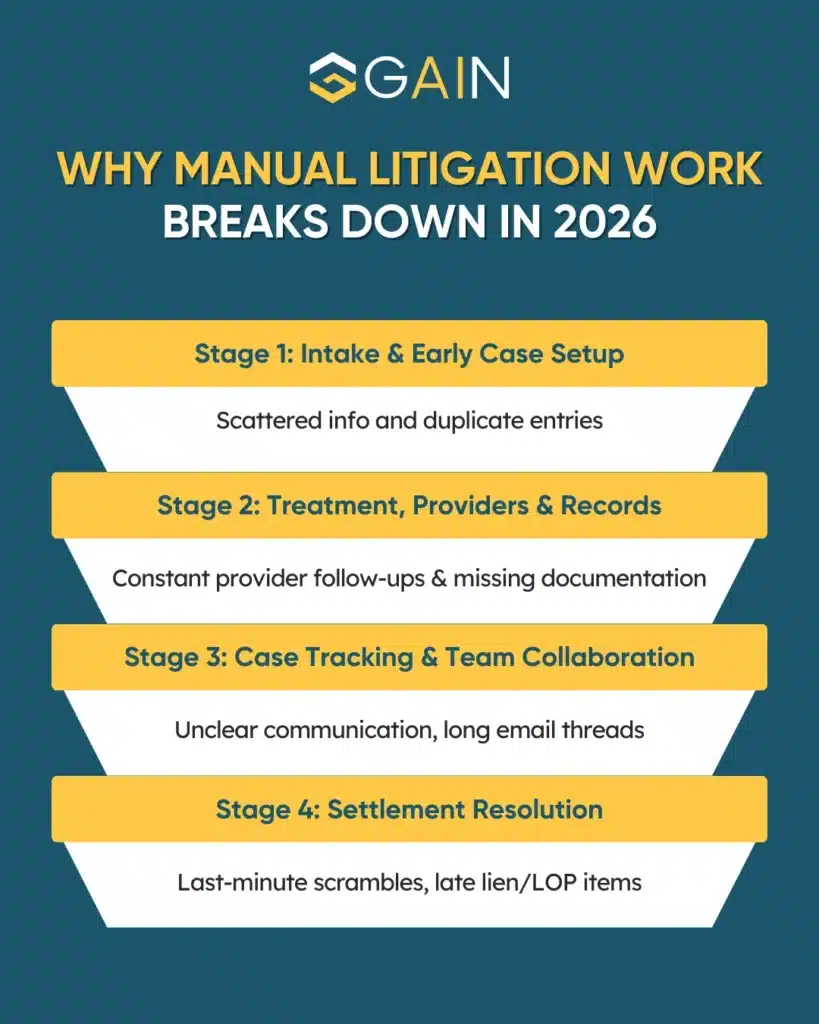
In short, manual methods cost momentum. And in 2026, momentum is often the difference between a clean settlement path and a case that drags for months longer than it should.
What a Modern Litigation Support Software Centralizes
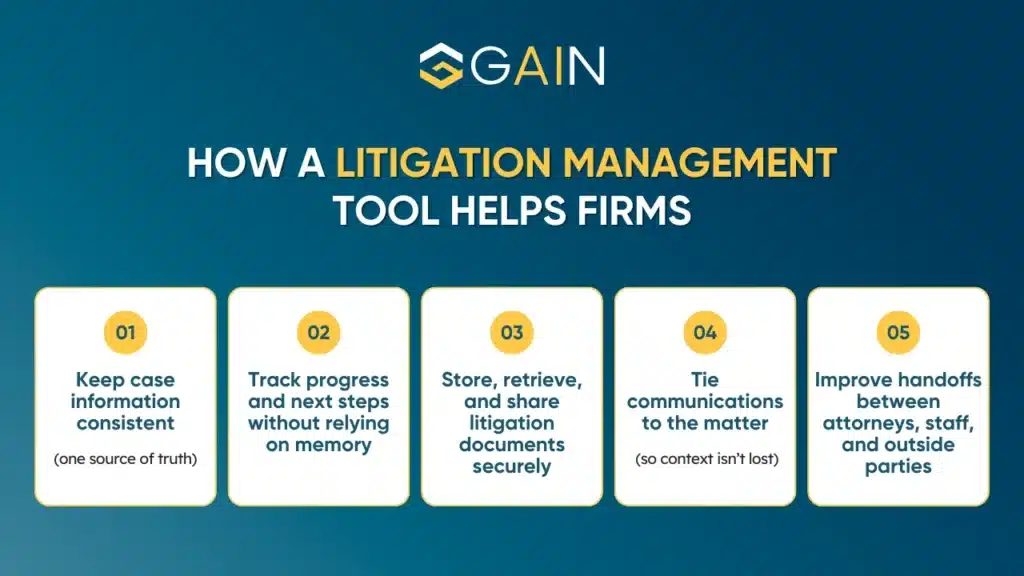
A modern litigation software for attorneys helps centralize a few essential realities of litigation work.
A Single Case Source of Truth
Instead of the case living across inboxes and folders, your case record should hold the current status, with all key documents and running history in one place.
Collaboration That Stays Tied to the Matter
The best litigation software for attorneys keeps communication connected to the case. It ensures all messages, requests, updates, and notifications are organized in one place.
Document Organization That Supports Settlement Readiness
Litigation is document-heavy. But the real goal is having the right documents, organized in a way that supports evaluation, negotiation, lien resolution, and settlement execution.
Visibility Into What’s Stuck
A strong litigation management tool makes bottlenecks visible. It offers real, measurable signals that show where cases slow down and what needs attention next. This is why many firms view a litigation management tool as one of the best platforms for managing crisis-related litigation.
Key Features of a Litigation Management Software
Here are the features that support real litigation workflows effectively.
- Centralized case dashboard and status tracking: your team sees case progress at a glance, what stage the matter is in, what’s pending, and what’s next, turning case management from reactive to proactive.
- Secure document storage and fast retrieval: a core function of software for litigation is keeping case documents organized and accessible, with simple categorization for medical records, bills, letters, authorizations, and liens.
- Messaging and notifications tied to the case: good litigation support software reduces email overload by keeping communication connected to the matter, so the team doesn’t chase scattered updates.
- Workflow support for moving the case forward: capturing requests, tracking documents, logging updates, and keeping tasks visible so nothing quietly stalls.
- Collaboration support for outside parties: providers, clients, and funders can exchange updates and documents without the firm losing control of access and permissions.
- Reporting that helps you manage: dashboards should answer where delays are happening most, which case stages are slowest, and what’s impacting settlement timing, not just look good.
Medical Coordination and Provider Connectivity
If your team spends hours locating providers, scheduling, and managing medical records, a more streamlined system is of utmost importance. GAIN Servicing offers provider connectivity tools where attorneys can easily search for and schedule client medical care.
Lien, LOP, and Settlement-Adjacent Support
Personal injury litigation firms treat this as a core requirement. Tools like GAIN Servicing offer full support for healthcare providers managing Letters of Protection, while monitoring cases to keep parties informed and aimed at optimizing collections and settlement outcomes. This level of support is part of what separates a true litigation management system from generic project tracking software.
How Litigation Management Software Boosts Productivity
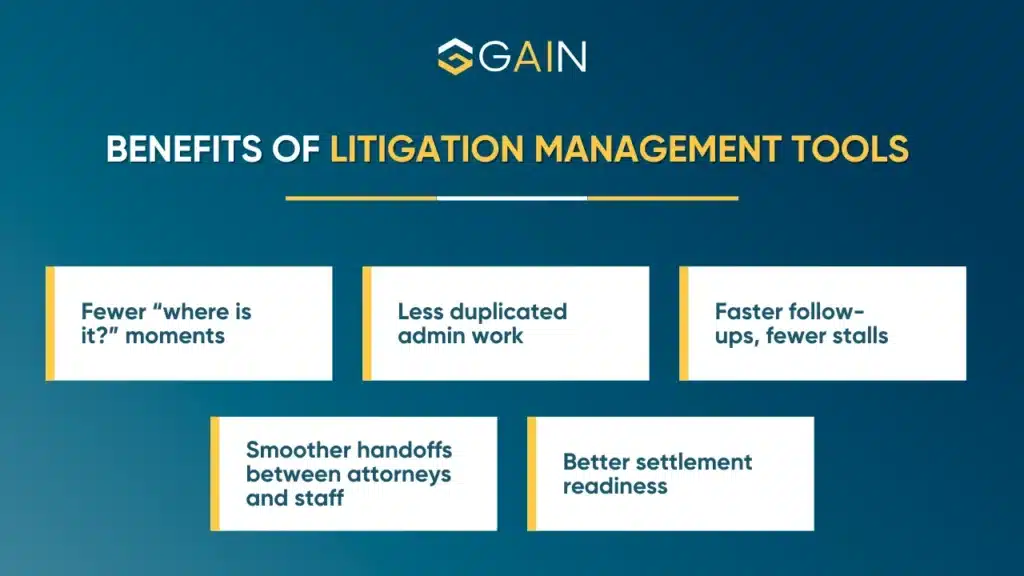
Productivity gains from litigation management software come from removing small delays that stack up across a case’s lifespan. Here’s what that looks like in real firm terms:
- Less time spent searching for documents, since records live in one organized system instead of scattered inboxes and folders.
- Fewer status-check calls and emails, since case progress is visible to the whole team at a glance.
- Faster handoffs between attorneys, paralegals, and case managers, since notes and history stay attached to the matter.
- Earlier intervention on stalled cases, since dashboards surface bottlenecks before they become serious delays.
Many firms also pair this with broader legal software for law firms to cover practice-wide needs like billing and document automation alongside case-specific litigation tracking.
How GAIN Servicing Helps Firms with Litigation Management
A lot of litigation software tries to be everything for everyone. GAIN Servicing is more purpose-built. It’s designed to connect personal injury attorneys and healthcare providers and simplify the operational realities of PI case progression.
It Centralizes the Case Details
The platform’s patient record center helps firms update and retrieve information and documents, with secure document storage and a messaging system to share important records and updates.
It Supports the Medical Coordination Side of PI Litigation
For firms, coordinating medical care can be a major source of delay, especially when treatment needs to be scheduled quickly and documented consistently. GAIN Servicing helps attorneys find and schedule care with verified providers and even request related assistance like transportation.
It Brings Visibility Through Reporting and Case Metrics
GAIN Servicing offers AI-enhanced dashboards and reporting to monitor case status and financials, with analytics down to individual cases. It’s a way to see what’s slowing cases down and manage your workflow with data, not gut feel.
It Can Reduce Settlement Pressure Through Pre-Settlement Funding
In some cases, financial pressure on plaintiffs can push premature settlements. GAIN Servicing offers pre-settlement funding for plaintiffs, a non-recourse structure with fast funding after approval. For attorneys, this can be relevant as part of a broader strategy to keep a case stable while it progresses.
Choosing the Right Litigation Management Tool
Not every firm needs the same litigation management tool. The right fit usually comes down to caseload type, team size, and how much medical or financial coordination a matter requires.
A few questions worth asking before committing to a platform:
- Does it match the volume and complexity of your actual caseload, rather than offering generic features you won’t use?
- Does it integrate medical record requests, lien tracking, and settlement-adjacent work, or just basic case status?
- Can your team realistically pilot it on a few active matters before a full rollout?