
TL;DR
Mass tort case management software is a purpose-built platform that helps law firms manage thousands of plaintiffs simultaneously, from intake and document retrieval through settlement. It centralizes plaintiff tracking, automates follow-ups, and gives every team member real-time visibility into case status across the full litigation lifecycle.
This guide covers what mass tort case management software does, the specific challenges it addresses, essential features to evaluate, and best practices for managing high-volume litigation efficiently.
Mass tort litigation operates at a scale standard legal tools were not built to handle. A single matter can involve thousands of plaintiffs, hundreds of medical providers, and years of ongoing documentation. Managing that volume without purpose-built software creates errors, delays, and lost revenue.
According to the JPML data, MDL cases have represented more than 70% of the federal civil caseload in recent years. That concentration makes the operational demands on mass tort firms unlike anything general-purpose legal software was designed to support.
This guide explains what mass tort case management software does, the specific challenges it addresses, the features that matter most in a purpose-built platform, and the best practices that separate high-performing mass tort operations from ones that struggle to scale.
What Is Mass Tort Case Management Software?
Mass tort case management software helps law firms organize and track large groups of plaintiffs in the same litigation. Understanding what case management means at this scale: unlike standard tools, mass tort platforms handle simultaneous oversight of thousands of individual matters.
Each plaintiff retains an individual claim with their own medical history and settlement position. The software tracks each individually while enabling the firm to manage the litigation as a whole. That dual requirement is what separates mass tort law software from standard PI tools.
Unlike standard legal case management software, mass tort platforms are built for intake at scale, multi-plaintiff tracking, bulk document management, and coordinated communication across large teams and multiple law firms.
Unique Challenges in Managing Mass Tort Cases
Mass tort litigation requires coordination across plaintiffs, attorneys, medical providers, and external vendors simultaneously. Each of these coordination points becomes a failure risk without the right mass tort case software management infrastructure in place.
- High-volume intake: thousands of plaintiffs need to be processed and qualified quickly. Inconsistent intake forms or manual qualification processes create data errors that compound across the case.
- Complex record retrieval: collecting medical records from multiple providers across multiple plaintiffs is enormously time-intensive. Each record request must be tracked, followed up on, and organized by plaintiff.
- Fragmented data: case notes, evidence, and medical files spread across email, shared drives, and paper create a version control problem that grows worse as the litigation ages.
- Communication breakdowns: attorneys, paralegals, and vendors using different channels cause delays and misalignment, particularly when multiple firms share the litigation.
- Plaintiff tracking at scale: monitoring treatment progress, injury severity, and documentation status for thousands of claimants requires automated tracking that manual processes cannot replicate.
- Multi-jurisdiction deadlines: MDL and state court proceedings run on different timelines. Missing a filing or discovery deadline in any jurisdiction affects the entire matter.
- Settlement tiering: plaintiffs fall into different settlement groups based on injury severity and criteria established during discovery. Maintaining accurate tier assignments requires consistent data across every file.
These challenges are not simply organizational. Each one carries financial and professional consequences. A missed record request delays settlement. An intake error disqualifies a plaintiff. A communication gap between firms creates conflicting positions at a critical negotiation stage.
Best Practices for Mass Tort Case Management
Strong law firm management practices in mass tort litigation depend on standardization, centralization, and automation working together. Firms that build these systems deliberately handle higher plaintiff volumes with fewer errors and faster case progression.
Standardize Intake From Day One
Inconsistent intake is the most common source of downstream problems in mass tort litigation. When different staff members collect plaintiff data differently, the errors compound across thousands of files. Standardized forms with required fields, consistent qualification questions, and automated validation reduce those errors at the source.
Build the intake template before the first plaintiff is signed. Define which fields are mandatory, how medical history is recorded, and how exposure documentation is captured. Changing intake protocols mid-litigation creates reconciliation work that is expensive and time-consuming.
Centralize All Plaintiff and Document Data
All data from intake forms to medical records to settlement correspondence should live in one platform, not distributed across email threads, shared drives, and individual attorney files. When the record is centralized, every team member works from the same information with the same status visibility.
Centralization also enables leadership oversight. A managing partner who can see the full status of every active plaintiff file without requesting reports from individual attorneys operates with meaningfully better visibility into risk and progress.
Automate Follow-Up and Deadline Tracking
New technology for law firms has made it practical to automate the follow-up workflows that previously required dedicated paralegal time. Automated reminders for record retrieval, treatment updates, and settlement documentation reduce the risk of deadlines being missed across a large plaintiff pool.
Set automated triggers at defined intervals: if a medical record request has not been fulfilled in 30 days, the system escalates it. If a plaintiff has not updated their treatment status in 60 days, the paralegal receives an alert. These rules run automatically without requiring manual calendar checks.
Track Treatment, Injuries, and Settlement Tiers Consistently
Settlement value in a mass tort case depends directly on the accuracy of each plaintiff’s injury and treatment documentation. Tier assignments made on incomplete data expose the firm to challenges at settlement. Real-time tracking of treatment progress, injury severity, and documentation status keeps tier assignments current and defensible.
Use Analytics to Prioritize and Monitor the Docket
Dashboards and reporting tools help leadership identify which cases are settlement-ready, which are at risk of deadline violations, and where the team needs to focus its effort. In a docket of thousands of plaintiffs, prioritization based on data outperforms manual review by a wide margin.
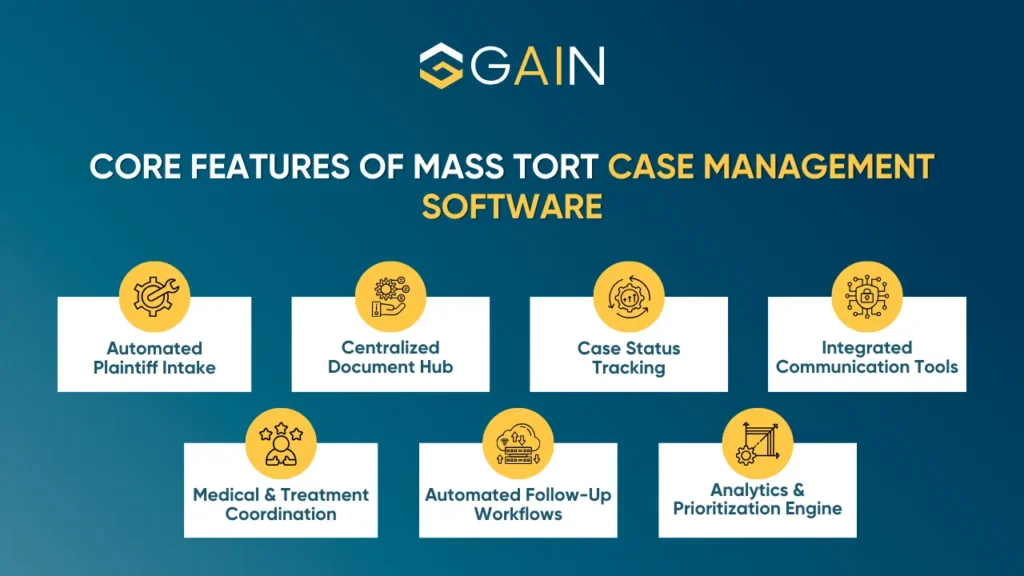
Key Features of Mass Tort Case Management Software
The benefits of case management software are most significant in mass tort practice, where the operational demands exceed what any general-purpose legal platform can support. Here are the features that matter most.
Centralized Plaintiff Dashboard
A unified dashboard where attorneys can search, view, and manage all plaintiff details in one place is foundational. It should display case status metrics, flag items needing attention, and allow filtering by litigation stage, injury type, and settlement tier. Without this, supervising a large docket requires constant manual status requests.
Structured Mass Tort Intake
High-volume intake requires rapid onboarding with consistent data capture. The intake workflow should allow firms to collect key plaintiff details, upload intake files, and begin automatic file organization from the first touchpoint. Optional advanced fields support deeper data capture for complex qualification criteria.
Document Management and Record Retrieval
Document volume in mass tort cases is enormous. Purpose-built mass tort law tools should allow attorneys to upload, request, download, and organize all documents from one location. Features like drag-and-drop uploading, bulk document requests, and file grouping by type reduce the administrative load on record retrieval workflows.
Full-text search and OCR capability for scanned records are equally important. When a team member needs a specific radiology report from a specific plaintiff in a 5,000-person docket, retrieval should take seconds.
Automated Status Updates and Notifications
Managing thousands of plaintiffs means constant status changes. Color-coded alerts that show which cases need attention, one-click status updates, and automated notifications for case changes reduce the administrative load while keeping the full team informed without requiring individual check-ins.
Integrated Communication Tools
In mass tort litigation, communication must be centralized for consistency. Built-in case messaging that stores all messages as part of the plaintiff record eliminates the risk of critical communications being buried in email or lost when staff turns over. It also creates an auditable record of all case communications.
Multi-Party Collaboration and Permissions
Mass torts involve multiple firms, providers, and administrative teams. The right legal software for law firms enables nationwide provider search, secure document sharing, and role-based permissions that control what each user can see and do within the platform.
Settlement and Payoff Tools
As cases move toward settlement, teams need fast, accurate payoff information and reduction request handling. Automated settlement calculations, tier-based compensation matrices, and payoff tracking reduce the manual work at the most critical stage of the litigation.
How to Choose the Right Mass Tort Law Software
Not every legal platform can scale to the demands of mass tort litigation. General-purpose platforms cover scheduling and billing but lack the plaintiff tracking, bulk document management, and automated follow-up systems that high-volume litigation requires.
When evaluating mass tort case software management tools, assess on five criteria:
- Plaintiff tracking at scale: the platform must handle thousands of individual files simultaneously with consistent data integrity across all records.
- Intake standardization: built-in intake templates, required fields, and qualification workflows reduce the data errors that compound at volume.
- Document management depth: bulk uploads, automated record requests, full-text search, and file grouping by type are non-negotiable for large dockets.
- Automation capability: follow-up reminders, deadline alerts, and status triggers should run automatically without requiring manual calendar management.
- Multi-firm collaboration: if multiple firms share the litigation, the platform must support role-based access and secure document sharing across organizations.