
Key Takeaways
Mass tort case management software is a specialized platform designed to help personal injury law firms manage thousands of plaintiffs at once by streamlining intake, automating documentation, centralizing communication, and ensuring accurate tracking across every case. It allows attorneys to scale litigation efforts without losing visibility or control.
In this guide, you’ll learn:
- What mass tort case management software is and why firms rely on it
- Unique challenges mass tort firms face
- Best practices for high-volume case management
- Essential features found in modern mass tort platforms
- How Gain Servicing improves efficiency for PI and mass tort teams
What Is a Mass Tort Case Management Software?
Mass tort case management software is a digital platform that helps law firms organize, track, and manage large groups of plaintiffs involved in the same litigation. Mass tort cases require consistent data entry, timely documentation, qualification tracking, and ongoing communication with both plaintiffs and medical providers. Without a system built for scale, errors and delays become unavoidable.
Unlike traditional personal injury tools, mass tort platforms support:
- High-volume mass tort intake
- Centralized document management
- Timelines for thousands of plaintiffs
- Automation of repetitive tasks
- Multi-party collaboration
- Large-scale reporting and analytics
As firms increasingly handle nationwide evolving litigations—such as product liability or pharmaceutical cases—the need for advanced mass tort case management software has become essential.
Unique Challenges with Managing Mass Tort Cases
Mass tort litigation involves extensive coordination across plaintiffs, attorneys, providers, and external vendors. Traditional spreadsheets or generic case management tools simply cannot keep pace.
Key challenges include:
- High-volume intake: Thousands of plaintiffs need to be processed and qualified quickly.
- Complex mass tort record retrieval: Collecting medical records and documentation from multiple providers is time-intensive.
- Disorganized data sources: Case notes, evidence, and medical files often live across emails, drives, or paper files.
- Inconsistent communication: Attorneys, paralegals, and vendors may use different channels, causing delays.
- Plaintiff tracking: Monitoring treatment, injury severity, and required updates at scale is difficult without automation.
- Deadline management: Multi-jurisdiction cases require strict compliance with filing, discovery, and settlement timelines.
- Settlement tiers: Plaintiffs fall into different settlement groups based on injuries or other criteria, requiring consistent categorization.
Best Practices for Mass Tort Case Management
1. Standardize Mass Tort Intake
Use consistent forms and qualification questions to minimize data inaccuracies across thousands of plaintiffs.
2. Centralize Plaintiff & Document Data
All data—from intake forms to medical records—should live in one platform instead of scattered systems.
3. Automate Follow-Up Tasks
Automated reminders help teams stay ahead of deadlines, especially for record retrieval, medical treatment updates, and settlement documentation.
4. Improve Internal & External Communication
Using one system ensures attorneys, paralegals, providers, and law firms communicate consistently and avoid misalignment.
5. Track Treatment, Injuries & Case Progress
Real-time plaintiff updates help determine settlement tiers and avoid delays.
6. Use Analytics to Prioritize Cases
Dashboards and insights help identify which cases are payout-ready or at risk of delay.
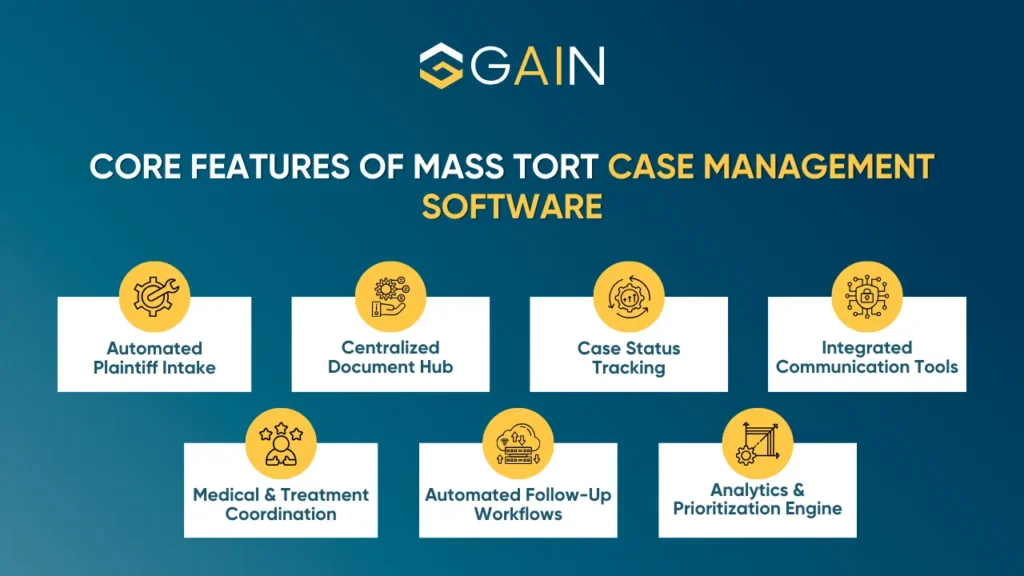
Key Features of Mass Tort Case Management Software
Centralized Case & Plaintiff Management Dashboard
Gain offers a unified dashboard where attorneys can view metrics, search for clients, and manage plaintiff details. This is ideal for mass tort firms handling large volumes of cases.
Key capabilities include:
- Dashboard metrics for quick visibility
- Search, view, and manage clients in one place
- Easy access to key plaintiff information
Fast & Structured Mass Tort Intake
Mass tort intake requires rapid onboarding of large numbers of plaintiffs. Gain’s “Add New Client” workflow enables firms to collect key details, upload intake files, and centralize documentation instantly.
Features include:
- Add new client in seconds
- Upload intake files at the start
- Automatic file organization
- Optional advanced form fields for deeper data capture
Document Upload, Retrieval & Organization
Document volume in mass tort cases is enormous. Gain solves this by allowing attorneys to upload, request, download, and organize all documents from one location.
Capabilities include:
- Drag-and-drop uploading
- View all case documents in a single location
- Request missing documents via built-in tools
- Download all files or select specific ones
- Combine files, group by type, or export in multiple formats
Ideal for mass tort record retrieval workflows.
Automated Case Status Updates & Notifications
Managing thousands of plaintiffs means constant status updates. Gain simplifies this with one-click updates and color-coded alerts that show which cases need attention.
Highlights include:
- Color-coded cases needing updates
- One-click status dropdowns
- Automatic notifications for case changes
- Tailored settings for attorney or paralegal preferences
Perfect for staying ahead of mass tort deadlines.
Integrated Communication Tools (No Emails or Phone Calls)
In mass tort litigation, communication must be centralized for consistency. Gain replaces traditional emails and phone calls with built-in case messaging tools.
Key benefits:
- All messages stored as part of plaintiff record
- Eliminates lost or buried communication
- Immediate alerts for new messages
- Connects attorneys, paralegals & providers in one channel
This is essential for large-scale plaintiff coordination.
Medical Treatment & Cash Advance Coordination
Mass tort cases often involve repeat coordination with medical providers and plaintiff funding partners. Gain’s platform includes tools to request medical treatment and manage cash advance requests.
Capabilities include:
- Request medical treatment directly
- Request and track cash advances
- View medical invoices and payment histories
- Monitor ongoing treatment progress
This is highly valuable in mass tort cases involving medical injuries or long-term treatment.
Payoff & Reduction Request Tools for Settlement Prep
As mass tort cases move toward settlement, attorneys need fast, accurate payoff information. Gain offers instant payoff totals and automated reduction request handling.
Provider & Attorney Collaboration Tools
Mass torts involve multiple firms, providers, and administrative teams. Gain enables them to collaborate seamlessly.
Capabilities include:
- Nationwide provider search
- Invite attorneys, paralegals, and staff
- Manage permissions and roles
- Share documents securely
How Gain Servicing Streamlines Workflows for Mass Tort & PI Firms
Mass tort firms need platforms that unify cases, documents, communications, and analytics at scale. Gain Servicing provides this through a SaaS-based, AI-supported collaboration portal.
Key advantages include:
- A single portal for attorneys, providers, and operational teams
- Automated notifications to prevent bottlenecks
- Easy case status updates
- Real-time visibility into plaintiff progress
- Streamlined medical treatment and cash advance workflows
- Communication tools that replace email chains
- Centralized document access and faster retrieval
For firms managing large plaintiff groups, Gain helps increase speed, consistency, and operational accuracy.
FAQs
What is the best legal case management system?
The best system depends on the firm’s caseload and practice type. For mass tort and personal injury firms, platforms that offer centralized intake, document management, automated updates, and communication tools are essential. Look for systems built specifically for high-volume litigation needs.
How does a mass tort case work?
A mass tort case consolidates many plaintiffs who share similar injuries caused by the same product, service, or event. Each plaintiff maintains an individual claim, while courts streamline proceedings. Firms must manage thousands of records, treatments, and communications throughout the litigation process.
How does a mass tort lawsuit work?
A mass tort lawsuit involves coordinated discovery, plaintiff vetting, evidence collection, and expert review. Cases are often grouped into tiers based on injury severity. While litigation is centralized, each plaintiff’s compensation is evaluated individually.
How long does it take to settle a mass tort case?
Mass tort cases typically take several years due to extensive discovery, medical review, negotiations, and court procedures. Factors such as injury complexity, number of plaintiffs, and defendant cooperation affect settlement timelines.
Best software tools for mass tort case management
Tools should support high-volume intake, document automation, real-time updates, record retrieval, and multi-party collaboration. Platforms built for PI and mass tort workflows typically offer better scalability than general-purpose legal software.
How to streamline document management in mass tort cases
Use centralized platforms that allow bulk uploads, automated requests, drag-and-drop file management, and unified storage. This eliminates scattered emails and helps teams quickly retrieve critical documents.
Top platforms offering mass tort case management solutions
Top platforms provide mass tort intake automation, plaintiff tracking, record organization, deadline alerts, and multi-firm collaboration features. Solutions designed for PI and mass tort practices generally outperform generic tools.
Features to look for in mass tort case management software
Essential features include: high-volume intake, automated record retrieval, centralized document storage, communication tools, status updates, and analytics dashboards. Look for platforms built to scale and support multi-plaintiff workflows.