In many car accident claims, proving what happened in the moments before impact is often the hardest part. Witness accounts differ, drivers dispute fault, and damage alone rarely explains the full story.
That is why car accident evidence increasingly comes from dash cam footage and Event Data Recorder (EDR) data. This is the reality now in many vehicle accident cases. For attorneys, this can strengthen a car accident case. But courts require proper collection, authentication, and presentation of accident case evidence.
Understanding what courts accept, and managing this information effectively, can make difference between the claim and the proven case.
TL;DR/Summary
EDR data and dash cam footage can be admissible in car accident claims. But only if courts find them authentic, relevant, properly preserved, and legally obtained. Courts usually accept evidence supported by a clear chain of custody and context. State-specific rules, especially around audio recording consent and windshield placement, can affect whether video evidence is usable.
Event Data Recorder & Dashcam Video Evidence — What They Are and Why They Matter
Two major types of video evidence and digital crash data are increasingly shaping car crash claims.
Dash cams are cameras installed in vehicles that continuously record the road ahead (and sometimes inside the vehicle). These recordings may capture traffic conditions, driver behavior, road hazards, and the moment of impact.
Event Data Recorders (EDRs), on the other hand, are built into many modern vehicles. They automatically record technical vehicle data during a crash or near-crash event.
Together, these technologies provide objective car accident evidence that can help clarify fault and reconstruct the crash.
The National Highway Traffic Safety Administration (NHTSA) states that EDR systems are present in over 95% of vehicles. This is applicable for all cars manufactured after 2013 in the United States.
This widespread adoption means that in many vehicle accident cases, digital crash data may already exist. Even if neither driver realized it at the time.
What Data Does an EDR Record?
An Event Data Recorder captures key vehicle information seconds before, during, and immediately after a collision. This data is often critical in determining how the crash occurred.
Typical EDR data includes:
Vehicle speed prior to impact
Brake application and throttle position
Seatbelt usage
Steering input
Engine RPM
Airbag deployment timing
Delta-V (change in velocity during impact)
In a disputed car accident case, this information can confirm whether a driver attempted to brake. It can also show how fast the vehicle was moving, or whether safety systems activated properly.
For example:
If a driver claims they were slowing down before impact, EDR data may confirm or contradict that statement.
If speed is disputed, EDR readings can provide an objective estimate.
However, accessing this information often requires specialized forensic tools and sometimes a court order. This is especially true when the vehicle owner has not consented to data retrieval.
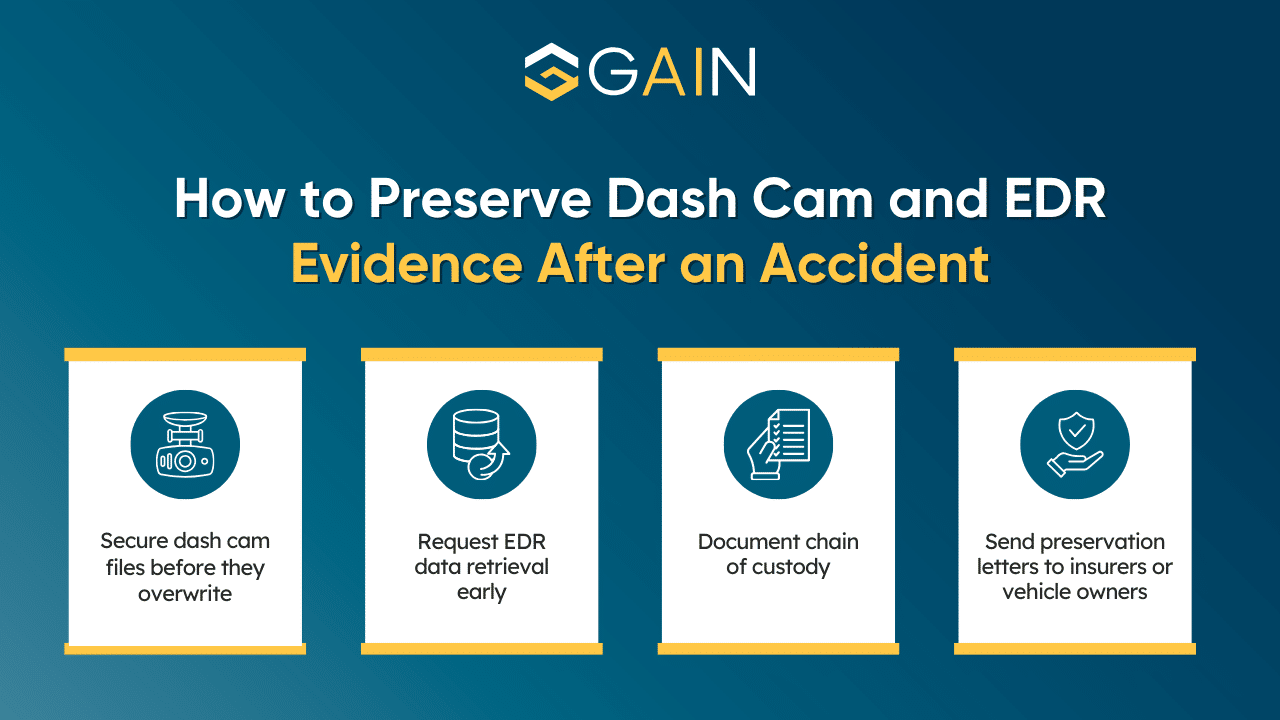
Because of these procedural requirements, attorneys handling car crash claims must ensure proper evidence preservation early in the investigation.
Is Dash Cam Footage Admissible in Court?
Yes. Courts often accept dash cam footage as valid car accident evidence, but only if it meets certain evidentiary standards.
To be admissible in court, video evidence must generally satisfy requirements such as:
Authentication, confirming the footage is genuine and unaltered
Relevance, proving the footage directly relates to the accident
Chain of custody, showing the evidence has been properly preserved
Compliance with privacy laws
If these conditions are met, dash cam footage can be extremely persuasive in vehicle accident cases. This is because it provides a real-time visual record of events. One should also preserve video footage after accidents; this is one of the most important things to do after a car accident.
Courts have accepted dashcam recordings in many accident lawsuits because they can demonstrate:
Lane violations
Traffic signal violations
Distracted driving
Sudden braking or unsafe maneuvers
Road or weather conditions
Unlike witness testimony, which can vary, video evidence often provides a neutral account of what occurred.
However, footage that is incomplete, edited, or lacking proper context may be challenged by opposing counsel.
State-Specific Dash Cam Laws
While dash cam footage is generally legal in the United States, the rules governing its use can vary by state.
Most regulations focus on two main issues: recording consent laws and windshield obstruction rules.
Legal Consideration
What It Means for Dash Cam Evidence
Audio recording consent laws
Some states require consent from all parties before recording audio inside the vehicle.
Windshield obstruction rules
Cameras must be installed in areas that do not block the driver’s view.
Evidence authenticity rules
Courts require proof that the footage has not been altered.
Privacy considerations
Recording private conversations without consent can create legal complications.
For example:
California requires two-party consent for audio recording.
Some states restrict where devices can be mounted on the windshield.
Evidence rules differ depending on the jurisdiction and the circumstances of the car accident case.
Hence, attorneys must evaluate accident case evidence within the legal framework of the specific state where the accident occurred.
How Dash Cam Footage and EDR Data Help in Accident Claims
When properly preserved and analyzed, both dash cam footage and EDR data can significantly strengthenpersonal injury car crash claims.
Establishing Fault
Videos may show who had the right of way or whether a red light was run. It may also show if there was unsafe driving that led to an accident.
Reconstructing the Crash
EDR data combined with video allows accident reconstruction experts to analyze speed, braking, and impact timing.
Challenging Disputed Testimony
If drivers or witnesses provide conflicting accounts, digital car accident evidence may clarify what actually happened.
Supporting Injury Claims
Crash severity data from an EDR can help demonstrate the force of impact, supporting medical injury claims.
Strengthening Settlement Negotiations
Clear video evidence and vehicle data often encourage insurers to settle earlier because liability becomes harder to dispute.
However, collecting and managing this information across multiple stakeholders like law firms, providers, insurers, and plaintiffs, can become complicated.
That’s where operational infrastructure becomes critical.
The Hidden Challenge: Managing Digital Evidence Across a Case
Modern car accident cases often involve multiple evidence sources:
dash cam footage
EDR data downloads
police reports
medical records
provider documentation
lien information
But these pieces are usually scattered across emails, files, and multiple stakeholders.
For firms handling large volumes of car crash claims, organizing this car accident evidence can become a major burden.
That’s where structured case workflows become essential.
How We Help at GAIN
As vehicle accident cases grow more complex, law firms are dealing with increasing volumes of digital evidence. This includes all types of medical records, digital crash data and video files.
Managing that information efficiently is essential to building a strong car accident case.
AtGAIN, we help you streamline the operational side of personal injury claims. This way, your team can focus on building the strongest case possible.
Our case management software supports firms by helping manage the workflows surrounding car accident evidence, including:
Coordinating medical records and documentation tied to accident injuries
Streamlining case-related information across stakeholders
Reducing administrative bottlenecks that slow down case preparation
Helping maintain organized records that support litigation readiness
We built GAIN to help your team stay organized, reduce administrative friction, and keep your car crash claims moving forward.
Final Takeaway
Digital evidence is reshaping how car accident claims are investigated and litigated. Between dash cam footage and EDR data, attorneys can clarify fault and support injury claims with stronger, more objective information. But turning that evidence into case progress requires more than legal strategy alone.
For firms handling vehicle accident cases, organized workflows, coordinated medical documentation, and fewer administrative bottlenecks can directly influence outcomes. That is exactly where a more streamlined case management software by GAIN can make day-to-day case management easier.
FAQs
What are the limitations of dash cam evidence?
While dash cam footage can be powerful car accident evidence, it has limitations. Cameras may not capture all angles of a crash, footage may be incomplete, and authenticity challenges may arise if the recording cannot be verified. Courts may also reject footage that violates privacy or recording laws.
When is dash cam footage useful in a car accident claim?
Dash cam footage is particularly useful when fault is disputed. It can show traffic signal violations, unsafe lane changes, or distracted driving. In many car crash claims, this type of video evidence provides a neutral record of events leading up to the accident.
Are there any legal challenges with EDR evidence in car accident claims?
Yes. Accessing EDR data may require vehicle owner consent or a court order. Attorneys must also ensure the data is retrieved using proper forensic tools and documented carefully to preserve its admissibility as accident case evidence.
How to collect video evidence at an accident scene?
If possible, drivers or witnesses should preserve video evidence immediately by saving dash cam recordings and capturing additional footage from nearby cameras or smartphones. Early evidence preservation helps ensure critical car accident evidence is not overwritten or lost.
What can qualify as video evidence after a car accident?
Several types of video evidence may support vehicle accident cases, including:
Dash cam recordings
Traffic camera footage
Surveillance cameras from nearby businesses
Smartphone recordings from witnesses
Body camera footage from responding officers
Each of these sources may contribute valuable accident case evidence depending on the circumstances of the crash.