
What if every medical record, provider update, lien balance, and case milestone was visible in one place, without chasing emails, spreadsheets, or phone calls?
That question sits at the core of modern personal injury case management.
Personal injury cases are not just legal matters. They are living processes involving injured plaintiffs, medical providers, financial obligations, and long settlement timelines.
Without a disciplined approach to case management, even strong legal strategies can lose momentum due to operational gaps.
This guide explains how structured personal injury case management works in practice and why checklists matter.
TL;DR – Personal Injury Case Management in Brief
Personal injury case management is the coordinated handling of legal tasks, medical treatment, documentation, and financial obligations throughout the life of an injury claim. When executed correctly, it reduces delays, improves settlement readiness, and protects case value.
In this guide, you will learn how to structure workflows, apply a practical checklist, overcome common challenges, and use purpose-built case management solutions, like Gain to streamline injury cases end to end.
What Personal Injury Case Management Really Means in Practice
At a practical level, personal injury case management ensures that nothing affecting case value happens in isolation. Case management in legal terms refers to the coordinated handling of legal proceedings, medical treatment, and financial obligations, ensuring that all three progress in alignment throughout the lifecycle of a case.
Unlike general legal case handling, injury matters involve:
- Ongoing medical care that evolves over time
- Multiple providers and specialists
- Letters of Protection and medical liens
- Plaintiffs under financial stress while waiting for settlement
This is why injury firms rely on structured injury case management, not ad-hoc coordination. The objective is simple: maintain full visibility and control from intake through resolution.
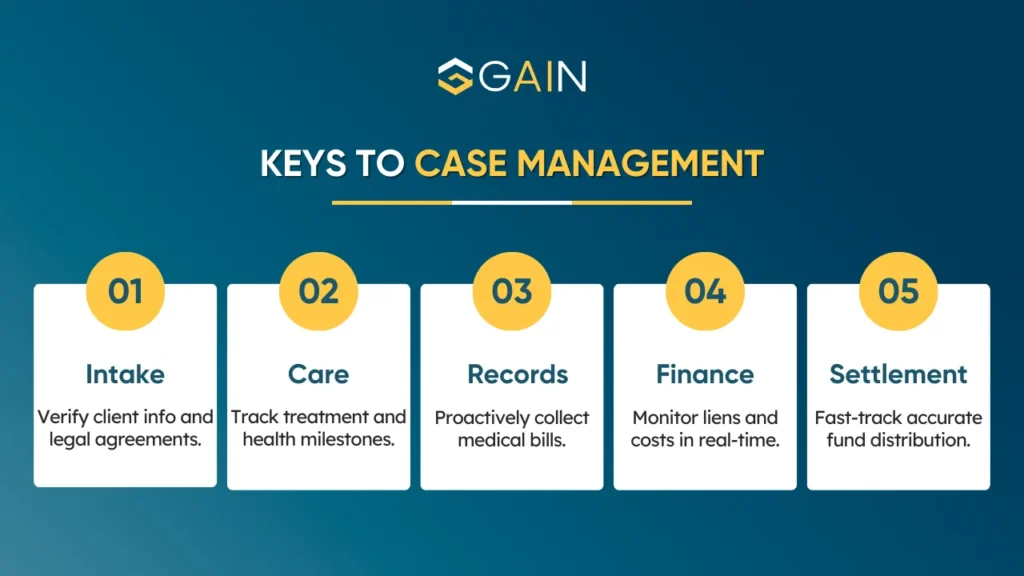
The Important Stages of Personal Injury Case Management
Strong personal injury case management follows a predictable lifecycle, even though no two cases are identical.
Case Intake and Foundation Setup
This stage establishes accuracy and consistency. Client details, incident facts, insurance information, and representation documents must be verified early to prevent downstream issues.
Medical Treatment Coordination
Medical care often spans months and multiple providers. Scheduling, referrals, diagnostic testing, and treatment progress must be tracked continuously, not retrospectively.
Documentation and Record Collection
Medical records and billing documents directly influence settlement value. Delayed collection weakens negotiation leverage and slows resolution.
Financial Oversight and Lien Servicing
Understanding Medical liens and LOPs require active management. Without real-time visibility, firms risk unexpected deductions or post-settlement disputes.
Settlement Readiness and Case Closure
A well-managed case reaches settlement with complete documentation, verified balances, and minimal friction, shortening closing timelines.
Common Breakdowns in Personal Injury Case Management
Even experienced firms encounter challenges when workflows are fragmented.
The most frequent issues include:
- Disconnected communication between attorneys, providers, and plaintiffs
- Missing or delayed medical records
- Poor visibility into outstanding liens and financial exposure
- Manual tracking through spreadsheets or emails
As per personal injury statistics trends of 2025, it consistently shows that operational inefficiency is not a legal merit, it is a leading cause of delayed settlements.
Why a Checklist Is Essential to Injury Case Management
A structured personal injury case checklist transforms complexity into repeatable control. It ensures that every case progresses through defined milestones, regardless of who is managing it.
Checklists reduce:
- Human error
- Case stagnation
- Last-minute documentation scrambles
- Financial surprises at settlement
It is also important to consider a personal injury case checklist for law firms, as many practices adapt these frameworks into firm-specific workflows that support consistency, efficiency, and better case oversight.
How to Build a Checklist That Fits Your Firm
Every firm operates differently. A checklist should reflect case volume, staffing structure, and technology maturity.
Small practices benefit from simplified workflows, while high-volume firms require automation.
It is important to understand that the case management software features must align with the depth of your checklist and your firm’s operational needs.
The goal is consistency—not complexity.
A Practical Personal Injury Case Management Checklist
Below is a structured personal injury case checklist designed for real-world application, not theory.
Intake & Case Setup
- Client and incident information verified
- Insurance details confirmed
- Representation agreements executed
- Initial medical needs assessed
Medical Care Coordination
- Providers identified and scheduled
- Treatment milestones tracked
- Specialist referrals documented
- Ongoing care status updated
Documentation Management
- Medical records requested continuously
- Bills collected as treatment progresses
- Diagnostic reports centralized
- Provider correspondence logged
Financial & Lien Oversight
- Letters of Protection monitored
- Medical lien balances tracked
- Settlement impact reviewed regularly
- Write-offs and negotiations documented
Settlement Preparation
- Records completeness verified
- Financial exposure finalized
- Case summary prepared
- Post-settlement distribution planned
This checklist complements broader personal injury guide resources while remaining operationally focused.
How Case Management Software Improves Injury Case Outcomes
Effective process case management tools actively reduce risk rather than simply storing information.
| Case Area | Manual Workflow | Gain Platform Approach |
| Medical records | Chased after treatment | Centralized patient record center |
| Communication | Emails and phone calls | In-platform messaging & alerts |
| Financial tracking | Estimates and spreadsheets | Real-time lien and settlement visibility |
| Oversight | Periodic reviews | AI-enhanced dashboards |
Firms comparing platforms should consider case management software factors to evaluate long-term ROI.
Why Gain Servicing Fits Modern Personal Injury Case Management
Gain is not a generic case management guide adapted for legal use. It is built specifically around personal injury workflows.
Gain supports:
- Case management systems for Attorneys managing complex legal timelines
- Medical providers accepting and servicing LOPs
- Plaintiffs needing uninterrupted access to care
- Financial workflows tied directly to settlements
Through its platform and managed services, Gain extends beyond software, actively handling lien servicing, provider coordination, and financial oversight.
Real-World Example: Coordinated Case Management in Action
Consider a motor vehicle injury case involving multiple providers. Without structured injury case management, the firm faces:
- Incomplete billing at settlement
- Unexpected lien disputes
- Delayed resolution
With Gain:
- Providers upload records in real time
- Financial exposure is transparent
- Attorneys negotiate with confidence
Operational clarity directly strengthens settlement outcomes.
Conclusion: Turning Personal Injury Complexity Into Control
Personal injury cases are complex by nature—but disorganization should never be part of the equation. Structured personal injury case management gives firms control over timelines, documentation, and financial outcomes while improving the client experience.
By combining disciplined checklists, modern case management technology, and hands-on operational support, Gain Servicing helps attorneys, providers, and plaintiffs stay aligned from intake to settlement.
If your firm is ready to move beyond fragmented workflows and manual tracking, Gain offers a proven way to streamline injury cases while protecting both care access and settlement value.
FAQs: Personal Injury Case Management & Software
Best personal injury case management software for law firms
The most effective platforms integrate legal workflows, medical coordination, and financial servicing. Gain stands out by supporting all three within one ecosystem.
How to choose personal injury case management tools for small legal practices
Small firms should prioritize automation and visibility. A case management software like Gain reduces manual follow-ups while remaining easy to implement.
How to implement digital case management for personal injury claims
Start by mapping current workflows, then align technology to those processes. Gain’s onboarding focuses on operational fit, not disruption.
Personal injury case management software with document automation
Gain centralizes records, automates updates, and ensures documents are settlement-ready without manual chasing.
Best case management software for personal injury attorneys
The best solutions extend beyond task tracking. Gain combines software, services, and financial tools to support the full case lifecycle.