
TL;DR
Law firm management refers to the strategic planning, operational oversight, and systems that allow a law firm to function efficiently as a business while delivering high-quality legal services. It covers leadership, financial controls, workflows, staffing, technology, and client experience.
By reading this guide, you’ll understand how law firms work operationally, how to build a scalable law firm structure, and how management best practices—combined with the right tools—can improve profitability, compliance, and long-term stability.
Running a law is about running a business with precision, structure, and accountability. Many attorneys build firms based on legal expertise, only to struggle later with inefficiencies, rising costs, poor intake systems, and operational blind spots. This is where law firm management becomes critical.
Law firms cite operational inefficiencies and financial oversight as their biggest internal challenges, especially as firms grow beyond a few attorneys. This highlights a clear truth: legal skill alone does not sustain a successful practice.
Modern law firms, especially personal injury and litigation-focused practices—must master structure, systems, leadership, and technology to remain competitive.
This guide explains what effective law firm management looks like, how law firms are structured, and which proven strategies help firms operate more efficiently while improving client outcomes.
What Is Law Firm Management?
At its core, law firm management is the discipline of running a legal practice like a well-organized business. While attorneys focus on advocacy, negotiations, and litigation, management ensures the firm operates efficiently behind the scenes.
This includes:
- Structuring teams and leadership roles
- Managing finances, billing, and expenses
- Standardizing workflows and procedures
- Implementing technology and case systems
- Overseeing compliance and documentation
For example, a mid-sized personal injury firm handling hundreds of active cases must coordinate medical records, provider communication, settlement timelines, and financial disbursements. Without strong management systems, even successful firms can experience delays, lost documentation, or revenue leakage.
Importance of Law Office Management
Effective law office management directly impacts client satisfaction, attorney productivity, and firm profitability. Poor management often leads to missed deadlines, inconsistent communication, and staff burnout.
Strong law office management allows firms to:
- Handle higher caseloads without chaos
- Improve response times during client intake
- Maintain accurate and compliant documentation
- Gain visibility into case and financial status
For legal firms working in personal injury, structured management becomes even more important due to medical billing, Letters of Protection, and extended settlement cycles.
Steps to Take for Successful Law Firm Management
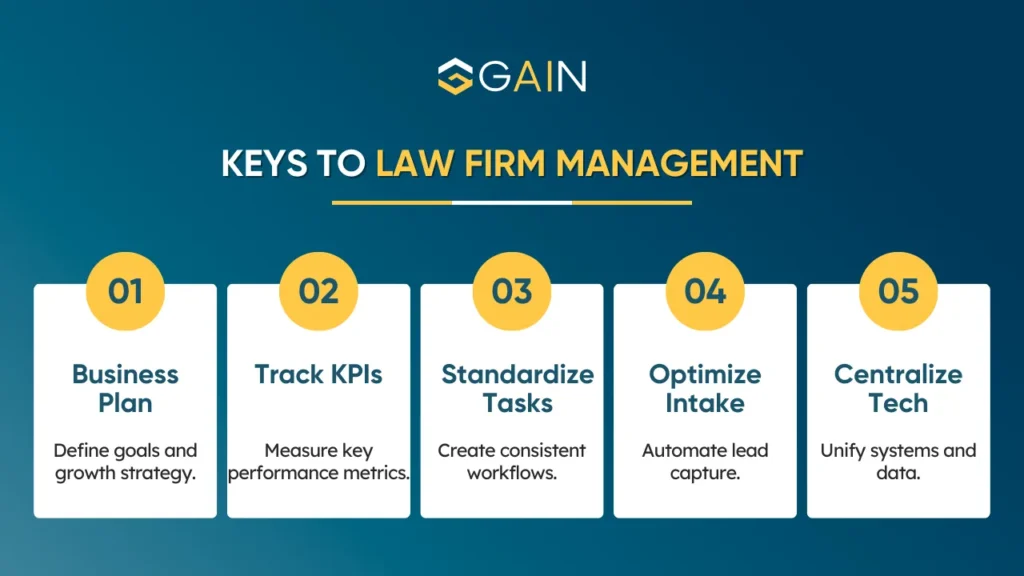
1. Create a Comprehensive Business Plan
Every effective law firm management strategy starts with a documented business plan. This plan should clearly define the firm’s practice areas, revenue goals, staffing model, and growth strategy.
A strong plan also clarifies law firm structure, including partner roles, operational oversight, and decision-making authority.
2. Define KPIs for Your Law Firm
Understanding how to manage a law firm requires measurable benchmarks. Key performance indicators (KPIs) help leadership evaluate whether the firm is operating efficiently.
Common KPIs include:
- Client intake conversion rates
- Average case duration
- Revenue per attorney
- Administrative cost ratios
- Settlement turnaround time
For management law firms, tracking these metrics enables data-driven decisions rather than guesswork.
3. Create a Law Firm Procedures Manual
Consistency is essential for scalable law office practice management. A procedures manual documents how tasks should be performed across the firm.
This manual typically includes:
- Client intake and onboarding steps
- Case documentation standards
- Communication protocols
- Compliance and security guidelines
For example, when onboarding new paralegals or case managers, documented procedures ensure continuity and reduce training time.
4. Optimize Your Intake Management
Client intake is often the first operational bottleneck. Delayed responses or incomplete data collection can cost firms valuable cases.
Effective law firm management prioritizes streamlined intake using digital forms, automated follow-ups, and centralized data storage. Many firms improve intake efficiency by aligning it with their broader case management workflows, reducing manual handoffs.
5. Create Repeatable Law Firm Processes
Repeatable processes turn complex legal operations into predictable systems. This is a core principle of strong law firm office management.
For example, personal injury firms that standardize medical record requests, provider communication, and settlement tracking reduce delays and improve internal accountability. Repeatable processes also reduce dependency on individual staff members.
6. Hire a Law Office Manager
As firms grow, attorneys should not be responsible for daily operations. Hiring a dedicated office manager allows leadership to focus on legal strategy while ensuring operational stability.
An office manager typically oversees:
- Staff coordination
- Technology systems
- Vendor and service providers
- Financial reporting
This role is essential for sustainable management law firms, especially those handling high-volume caseloads.
7. Invest in a Practice Management Platform
Technology is the backbone of modern law firm management. Practice management platforms centralize case data, documents, communication, and reporting into one system.
Many firms adopt structured platforms similar to those discussed in What Is Case Management Software?, which explains how centralized systems reduce errors and improve transparency across departments.
Additional Tips for Managing Personal Injury Law Firms
Personal injury firms face unique challenges, including medical documentation, lien tracking, and extended settlement timelines. Strong law office management ensures visibility across these moving parts.
For example, firms that use integrated case systems—similar to those outlined in Case Management System Examples for Law Firms, can track medical records, provider updates, and settlement status without relying on spreadsheets or email chains.
Effective Law Firm Management in Practice
True effectiveness in law firm management comes from alignment. Leadership, systems, and workflows must work together to support attorneys rather than slow them down.
Firms that invest in structured operations often see:
- Faster case resolution
- Improved staff retention
- Better client communication
- Reduced administrative risk
How Law Firms Can Maintain Financial Vigilance
Financial oversight is a cornerstone of sustainable law firm management. Firms must monitor cash flow, outstanding expenses, and case-related costs consistently.
Key practices include:
- Monthly financial reviews
- Clear trust account controls
- Forecasting settlement timelines
- Monitoring medical liens and receivables
Resources like benefits of Case Management Software explain how financial visibility improves decision-making without increasing administrative burden.
Investing in Marketing and Branding for Law Firms
Marketing supports growth, but it must align with operational capacity. Effective legal firms invest in branding that reflects professionalism, credibility, and clarity.
Strategic marketing efforts typically focus on:
- Practice area positioning
- Educational content for clients
- Reputation and review management
- Performance-based digital campaigns
Strong branding ensures consistent case flow without overwhelming internal systems.
Excelling in Law Office Leadership
Leadership directly impacts firm culture and performance. Clear communication, accountability, and structured decision-making are essential for effective law firm management.
Create a Strong Law Firm Hierarchy
A defined hierarchy supports clarity and efficiency. Clear reporting lines ensure tasks are completed consistently and issues are escalated appropriately. A well-defined law firm structure reduces confusion and supports long-term growth.
Tools for Law Office Management
Modern law office practice management relies on integrated tools rather than disconnected software. These tools typically support:
- Case tracking and deadlines
- Secure document management
- Client communication
- Analytics and reporting
Guides such as choosing the best case management software help firms evaluate solutions based on operational needs.
How Gain Helps Streamline Law Office Management
For personal injury practices, managing medical providers, documentation, and settlement workflows adds complexity. Platforms like Gain support law firm management by centralizing case-related communication, medical records, and financial coordination.
Many firms also explore operational support models similar to those described in Managed Services, where administrative and financial processes are handled alongside legal workflows—allowing attorneys to focus on advocacy and outcomes rather than coordination.
Frequently Asked Questions (FAQs)
Best software solutions for law firm management
The best solutions centralize cases, documents, communication, and reporting. Platforms that integrate intake and workflows offer the strongest support for modern law firm management.
Top case management tools for law firms
Top tools provide end-to-end visibility, automation, and compliance controls. Many firms evaluate options discussed in what software do most law firms use? to match features with firm size.
How to improve client intake process in a law firm
Improving intake requires digital forms, automated responses, and centralized case data. Streamlined intake supports stronger law office management and better client experience.
How to automate document management in a law office
Automation involves centralized repositories, access controls, and version tracking. Document automation reduces risk and supports scalable law firm office management.
Features to look for in law firm case management software
Key features include workflow automation, secure document storage, reporting, compliance tools, and integrations—essential for effective law firm management.