
If your firm feels “busy” all day but casework still piles up, there’s a workflow problem.
The truth is, many firms spend a chunk of the day on work that doesn’t directly move matters forward. These may include chasing updates, hunting for documents, or juggling client communications across email, texts, and spreadsheets.
The data backs up that gap between effort and output. As per a study, for each 8-hour workday, the average firm does 2.3 hours of billable work. That doesn’t mean attorneys aren’t working. It simply means the system around them is pulling time away from billable, high-value work.
This is where law firm efficiency becomes your competitive edge.
TL;DR: How to Improve Law Firm Efficiency?
When you standardize case workflows and use the right law firm productivity tools, you create a calmer environment. This is because fewer bottlenecks usually means more cases handled well, fewer write-offs, and cleaner collections. Here are some tips on how to get that:
- Start With an Efficiency Audit
- Build a Single Source of Truth
- Automate the Busywork
- Fix Client Intake and Communication
- Delegate and Outsource Strategically
- Use AI-Powered Tools for the Legal Industry
- Improve Law Firm Profitability With Better Metrics
- Get an Efficient Legal Office Tool Stack
Start With an Efficiency Audit
Start small and practical. Pick 3–5 workflows that impact revenue and client experience and map what actually happens today (not the ideal version). You’re looking for repeat friction: duplicate data entry, unclear ownership, and “waiting” steps that stall momentum.
Then track one normal week. Note where work begins (email, calls, spreadsheets), how many handoffs it takes to finish a task, and what keeps getting pushed to “tomorrow.” Even this lightweight audit helps you spot the quickest wins. It lets you create a clear shortlist of what an efficient legal office tool should fix first.
Build a Single Source of Truth for Matters, Documents, and Communication
A firm can’t run efficiently when case details live across inboxes, personal drives, sticky notes, and “someone’s spreadsheet.” A true “single source of truth” keeps matter status, key documents, deadlines, and communication history in one reliable place.
This is where law firm management tools earn its keep. It is because it reduces the two biggest productivity killers: searching and rework. When the latest document version is obvious and the next task is visible, your team spends more time on what matters.
Consistency matters here as well. Make sure to standardize file naming, matter stages, and who updates what. The goal isn’t perfection; it’s clarity.
Automate the Busywork That Slows Your Team Down
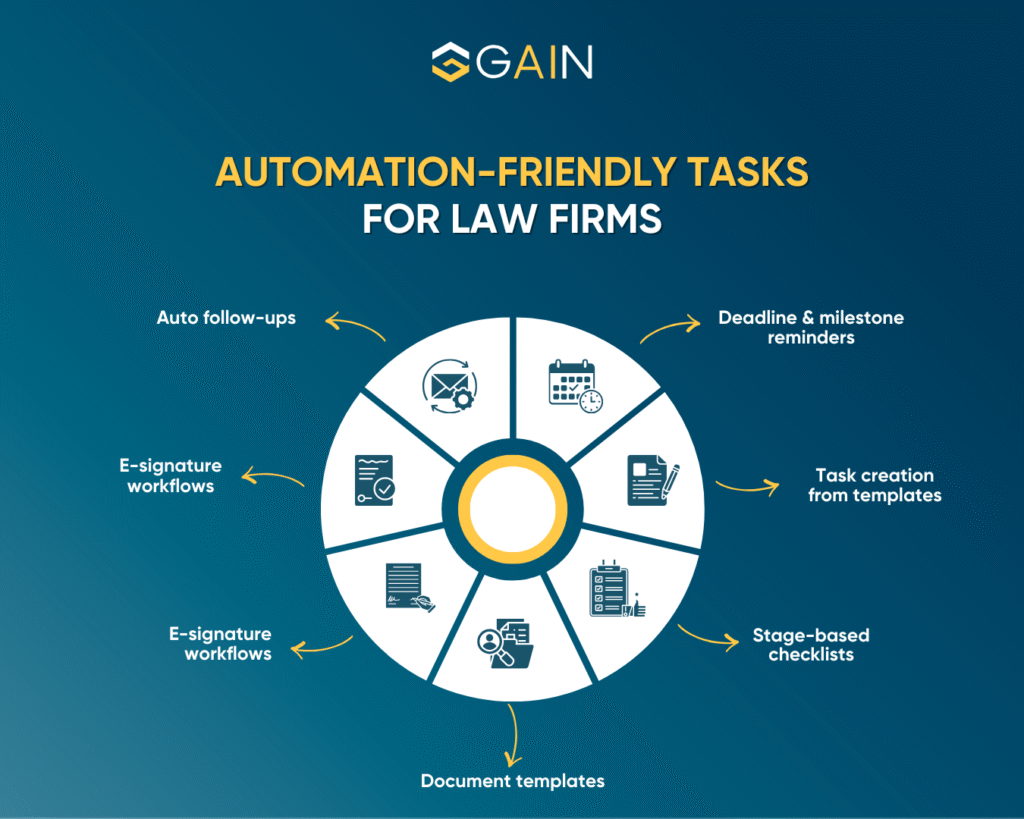
Automation is about removing repetitive steps that quietly steal hours. These include follow-ups, reminders, routing documents, creating tasks, and generating routine forms. Done well, automation is one of the most direct ways to improve law firm efficiency.
A useful rule? If a task is repeated the same way across matters, it deserves a template or trigger.
There’s real upside here. As per a study by McKinsey&Company, nearly 40% of activities in legal operations have the potential to be automated. Even if your firm captures only part of that, the payoff is significant. You will see fewer dropped balls, faster case movement, and cleaner handoffs.
Fix Client Intake and Communication
Many firms lose efficiency (and revenue) before a case even starts. This primarily happens due to slow response times, scattered intake notes, and inconsistent follow-up.
- Start by tightening the basics.
Get a structured intake form, clear next steps, and a defined owner for each stage (initial contact, screening, scheduling, onboarding). The handoff should be seamless. Information collected once should populate the matter automatically so you’re not retyping details into multiple systems.
- Communication is the other half.
Clients want predictability, so set expectations early. Proactively decide where updates happen, how to share documents, and where messages should go live. When conversations are captured in one place, you avoid miscommunication.
This is also where a truly efficient litigation management software helps. It helps to centralize messages, standardize update checkpoints, and create simple templates for common client questions. The result is smoother operations, better client experience, and a more reliable foundation for how to grow your law firm.
Delegate and Outsource Strategically
A surprisingly effective efficiency strategy is simply protecting attorney time. When lawyers are stuck doing coordination work, your firm loses capacity and momentum.
Attorney time should be concentrated on legal strategy, negotiation, client counseling, and high-stakes writing. On the other hand, operational steps are often better handled by trained staff or managed support.

For personal injury practices, this can be especially powerful. This is because case progress often depends on timely records, treatment coordination, and status updates. In this regard, GAIN Servicing plays its part effectively. It connects stakeholders and keeps matters moving with centralized updates and communication support, ensuring everyone stays on the same page.
Use AI-powered tools for the Legal Industry
AI is quickly becoming part of day-to-day operations. But the real gains come from using it in focused, low-risk ways.
The best early wins for AI for legal industry use are tasks that are repetitive and time-consuming, but still require human review. For example, research assistance, summarizing long materials, organizing information, and first-pass document review.
But guardrails matter, especially for artificial intelligence for legal professionals. It is important not to input sensitive client data into tools you haven’t vetted and treat outputs as drafts (not truth). Most importantly, attorney sign-off is a must.
Improve Law Firm Profitability With Better Metrics
If you’re trying to figure out how to improve law firm profitability, start by measuring what happens between “work performed” and “revenue collected.”
Three metrics are especially useful because they show where revenue leaks:
- utilization rate (how much time becomes billable)
- realization rate (how much billable work gets invoiced)
- collection rate (how much invoiced work gets collected)
When one is weak, profitability suffers even if everyone feels busy.
This is where operational fixes and financial outcomes connect. Cleaner workflows improve time capture and reduce write-downs. Better intake and communication reduce billing disputes. Standardized matter management reduces rework that can’t be billed. And dashboards make issues visible early, before they become month-end surprises.
Get an Efficient Legal Office Tool Stack
There isn’t one perfect stack for every firm. However, the buying criteria should stay consistent: your tools should reduce handoffs, eliminate duplicate entry, and make work visible. When evaluating law firm productivity software, look for capabilities that support a single operating system for the firm. It should not be another collection of disconnected apps.
Also consider how well the tool stack supports client intake, consistent communication, and billing hygiene. These are direct drivers of law firm efficiency and profitability.
For PI firms specifically, it’s worth prioritizing tools that support document-heavy workflows, frequent status updates, and coordination across parties. GAIN Servicing’s platform, for example, positions itself around a patient record center, messaging/notifications, and AI-enhanced reporting to monitor case status and financials. These capabilities readily align with operational efficiency in high-volume PI environments.
Final Take
With clear workflows, centralized information, and smart automation can support law firm success and show up in real profitability. As you adopt the right mix of law firm productivity tools, growth becomes less chaotic and more predictable. This is exactly what most firms need when they’re thinking about how to grow a law firm.
And if you want that progress to stick, it helps to have a system that is organized, consistent, with manual follow-up. That’s where GAIN Servicing can fit naturally by providing an efficient litigation management software built for operational clarity. With AI-enhanced insights and centralized case support, teams can now stay on track while keeping the client experience strong. With the right tool, yes, it’s that easy.
Frequently Asked Questions
What are the best software tools to improve law firm efficiency?
The best tools reduce admin work: a centralized case platform, automated tasks, document templates, secure messaging, reporting dashboards, and easy client intake. GAIN Servicing fits well for PI-focused teams by bringing case updates, records workflows, and AI-enhanced visibility into one smooth system.
How to automate document management in law firms?
Start with standardized templates, naming rules, and a single storage location tied to each matter. Add automated reminders for missing documents, version control, and role-based access. Then connect intake forms and e-signature steps so documents are created, routed, and filed automatically.
How to choose a case management system for a law firm?
Choose a system that centralizes matters, tasks, documents, and communication—so nothing lives in scattered inboxes. Prioritize automation, reporting, security, and workflows that match your practice area. For PI firms, GAIN Servicing stands out with records-focused workflows and AI-driven case visibility.
How to improve collaboration in law firms using technology?
Use shared matter timelines, task ownership, and one communication thread per case so updates don’t get lost. Add secure document sharing, role-based permissions, and automated status notifications. The goal is fewer internal check-ins and clearer handoffs between attorneys, staff, and partners.
What are the leading AI tools for legal document automation?
Look for AI that helps with drafting from templates, summarizing long documents, extracting key fields, and organizing files. But there should always be human review. For PI operations, GAIN Servicing adds AI-enhanced insights and structured workflows that keep documents and case progress moving predictably.
How to implement workflow automation in a midsize law firm?
Begin with one workflow (intake, records, billing) and map it end-to-end. Turn repeat steps into checklists, triggers, and templates, then assign clear owners and deadlines. Roll out in phases, track a few metrics monthly, and refine based on what’s actually improving efficiency.